

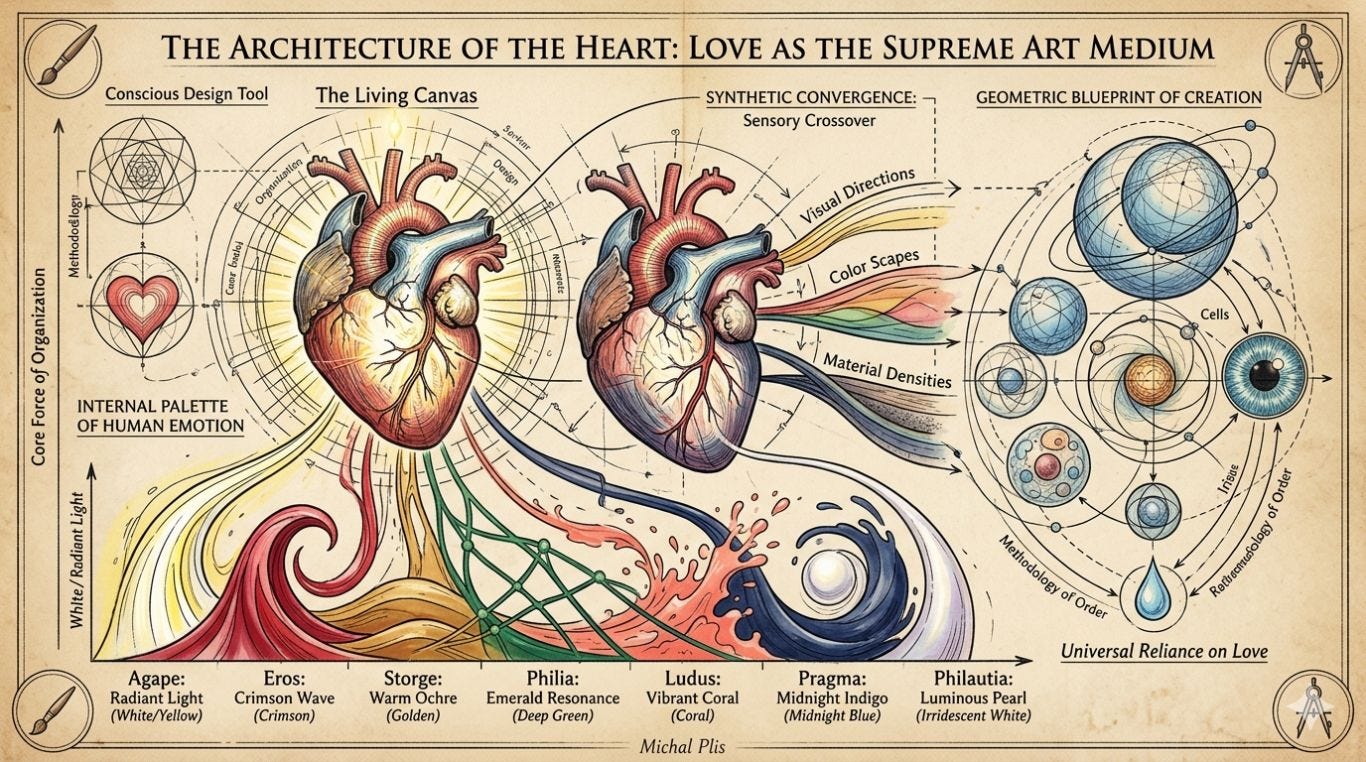
Is love the ultimate art form?
Every human on this planet is born an artist, equipped from birth with a foundational creative medium that requires no academic training to manifest, the capacity to love. We frequently mis-characterize love as a passive emotional state, a transient chemical reaction, or a fragile sentiment.
However, when analyzed through a structural lens, love reveals itself as a profound tool for conscious design. It is the core force that organizes reality, establishes structural harmony, and introduces a clear methodology of order into human existence.
When individuals deny themselves the active practice of this universal art form, when they permit their internal palettes to dry up through isolation or cynicism, they forfeit the opportunity to experience the true masterpiece of human happiness.
To live fully is to realize that we are all active creators, utilizing the medium of love to sculpt environments of joy, safety, and mutual understanding. Every act of human decency, every moment of deep devotion, is a deliberate brushstroke upon the shared canvas of our collective reality.
Obviously though, love without justice, wisdom, strength and other virtues is not well balanced, but this article focuses on the love as an art form and my related observations, therefore the grander balance of love with other virtues is a topic for another discussion.
Let's learn about love as an art form.
Colors of the Love Palette
To understand how love operates as a functional creative medium, we can look to the highly precise vocabularies of ancient Mediterranean languages, including Greek, Hebrew, and Arabic. These civilizations recognized that love is not a single, monochrome concept, but an expansive spectrum of distinct operational states.
In this blog I'm going to anthropomorphize different kinds of love and I will represent them as colors. But the idea of creating art with love is conceptualizing, experiences and connections.
The ancient Greeks identified several distinct concepts of love, utilizing different words to express the specific context, depth, and nature of the affection. Instead of using one blanket term, they categorized love into various types, ranging from passionate romance to universal selflessness. I'll be using Greek terms to describe the different loves in a color scheme below.
Agape: Radiant Light of Genesis
This is the ultimate, unselfish form of love, a brilliant white or warm yellow light, in a way, that represents the highest standard of creative intent. It stands as the primary foundation upon which the entire universe and human decency are built. For those who believe in the Creator of the Universe, This love is also between the Creator and the creation, particularly humans.
Agape love is a noble, unselfish love that is guided by moral principles and an intentional choice of the mind, rather than just passing emotions. It focuses entirely on seeking the genuine welfare and happiness of others, even those who might be difficult to love, without expecting anything in return. While it is rooted in duty and right principles, it is far from cold, often bringing a deeply warm affection and sincerity to relationships.
Agape does not depend on a reciprocal emotional return, it is a deliberate, reasoned choice to emit care, warmth, and protection. It acts as a pure, unwavering energy source, serving as the core foundation for a harmonious reality.
Eros: Crimson Wave of Passionate Intensity
Represented by a deep, intense crimson, Eros is the driving force of romantic devotion. It is full of kinetic movement and friction, a sharp ignition that demands immediate sensory focus and pulls two individuals into a singular, shared orbit. In the language of form, it is the initial spark that breaks a static plane, introducing raw vitality and emotional urgency into the human experience.
In ancient Greek, the word é·ros describes romantic and physical love, representing the passionate attraction that draws a man and a woman together in marriage. It's deeply personal. Interestingly, this specific word is never used by the writers of the Bible. While the Scriptures fully support romance and intimacy within the marriage arrangement, the Bible highlights that lasting relationships cannot survive on physical attraction alone. For romantic love to thrive, it must be balanced and guided by a·gá·pe, the selfless, principled love that prioritises the welfare of others above all else.
Deeper than Eros
True intimacy in marriage goes far deeper than a physical canvas. In a life lived as art, marriage is the ultimate collaboration, a space where two love artists shape a shared existence. The ancient Greek word for intimacy, Oikeiótita (οικειότητα), stems from oikos, meaning "home," reminding us that genuine connection is a safe, emotional sanctuary. While romantic passion (Eros) provides the initial spark that must be intentionally tended, a lasting masterpiece requires a richer palette: the deep friendship of Philia and the unselfish commitment of Agape and the other good loves. When these merge, the relationship transcends fleeting desire into a "one-flesh" union. Here, two love-artists foster mutual growth across every landscape, emotional, practical, and spiritual. Ultimately, real intimacy is the lifelong art form of crafting a safe home within each other's hearts and lives. When both are willing to be love artists the result is a unique and beautiful tapestry of life shared together woven with the art form of the different loves. To note is that true marital intimacy is also balanced with healthy solitude where each individual builds themselves and comes together regularly to build each other. Social balances the solitude. Solitude is explained in Philautia in a subheading below.
Storge: Warm Ochre of Continuity
Storge manifests as a grounded, reassuring golden ochre, the natural, instinctive love shared within families. It provides the quiet, enduring framework that protects early development. It carries no artistic pretense, offering instead a safe, resilient architecture where multiple generations can connect and find long-term stability.
In ancient Greek, the word stor·geʹ represents "natural affection", the instinctive, automatic love found within a family. In modern Greek, stor·geʹ is spelled στοργή (pronounced stor-YEE). It translates to affection or familial love. It is the quiet, enduring bond that naturally connects parents to their children and links brothers and sisters together. While the root word itself does not directly appear in the Bible, it is beautifully implied throughout the Scriptures as a fundamental building block of a peaceful home. In a world where family loyalties often fade, cultivating true stor·geʹ creates a reliable safe haven of warmth, forgiveness, and unconditional emotional security.
Philia: Emerald Resonance of Affinity
Philia represents the deep emerald green of profound, trusted friendship. It is the love of deep companionship, intellectual alignment, and shared values. This color introduces a soothing, balanced harmony to the palette, focusing on the beautiful networking between individual souls who choose to walk parallel paths in total trust.
In ancient Greek, the word phi·liʹa describes "friendship love", the deep, affectionate bond that develops between people with shared values and interests. Unlike family love, this warm personal attachment is chosen and built over time through mutual trust and companionship. The Bible highly values this form of love, frequently using its root words to highlight the close bond between true friends and the warm affection that should unite a community. It reminds us that while romantic feelings flare and fade, a connection rooted in genuine phi·liʹa provides the reliable, heartfelt emotional support we all need to thrive.
Ludus: Vibrant Coral of Playful Discovery
Ludus enters the palette as a vibrant, light-reactive coral, representing a carefree, flirtatious, and fun-loving manifestation of human connection. It is expressed through the quick rhythms of teasing, the shared movement of dancing, and the casual excitement of immediate interaction.
In design terms, it functions like a splash of fluorescent pigment, introducing playfulness, spontaneous light, and unburdened joy into the composition without demanding immediate permanent structure.
Though often mistaken for an ancient Greek concept, ludus is actually a Latin term that translates to "play" or "game." In the context of relationships, it represents playful, flirtatious, and uncommitted love, the lighthearted thrill of a new crush, casual banter, or the early stages of dating. While ludus keeps things fun, exciting, and free of pressure, it lacks the long-term depth of family affection (stor·geʹ) or selfless commitment (a·gá·pe). For a relationship to mature into something permanent, this casual "game of love" must eventually evolve into a deeper, shared bond.
Pragma: Midnight Indigo of Enduring Commitment
Pragma is a mature, realistic love founded on duty, compromise, and long-term commitment. It represents a profound partnership built to last through the changing seasons of life, requiring mutual effort, shared dedication, and a resilient structural core. Visually, this is represented by a deep, unyielding midnight indigo, a foundational color that stabilizes the layout, providing a permanent, reliable anchor that holds its form long after more volatile colors fade.
While the literal ancient Greek word pragma means "business" or "a practical matter," modern psychology uses it to describe "practical love" or "standing in love." Unlike romantic infatuation that strikes suddenly, pragma is a logical, head-over-heart connection focused on long-term compatibility, shared life goals, and mutual effort. It is the realistic, enduring bond found in couples who consciously choose to navigate life as a team. While it may lack the initial fire of é·ros, pragma provides the stable, sturdy foundation needed to keep a relationship thriving for decades.
Philautia: Luminous Pearl of Internal Balance
Philautia is the recognition of one's own fundamental worth, representing a healthy, necessary level of self-respect. The ancients understood that this internal harmony is required before an individual can fully extend care and love to the world around them. Represented by a highly reflective, luminous pearl pigment, Philautia functions as an internal mirror, collecting environmental light and bouncing it back outward, ensuring the core of the creator remains fully illuminated.
Representing "self-love," phi·lau·tiʹa is the ancient Greek concept that addresses our relationship with our own minds and bodies. The Greeks brilliantly divided this into two types: a toxic, arrogant narcissism, and a necessary, healthy self-compassion. Healthy philautia isn't about being selfish; it’s about understanding your own worth, maintaining a positive inner dialogue, and treating yourself with kindness. It serves as a gentle reminder for blog readers that we cannot pour from an empty cup, loving yourself securely is the vital first step toward truly loving anyone else.
Loneliness is bad, but solitude is a good time that one can spend with ourselves even in relationships, which recharges and builds you in order to build others. Even the perfect human Jesus while on earth found the time for solitude. That tells you something: balance life with socialising (with people, friends and most importantly family) and solitude (the time with you and your thoughts, hobbies, bodily and mental training). For someone neurodivergent like me, I have to watch this balance so my social battery doesn't burn out.
Mania: Over-Saturated Magenta of Chaotic Imbalance
Mania manifests as an obsessive or possessive form of love, frequently originating from deep-seated jealousy or a structural imbalance between Eros and Ludus. It can lead to codependency, frantic behavioral patterns, and an instability of focus. On our palette, it is represented by an over-saturated, corrosive magenta, a color so intense that it threatens to bleed past its boundaries, serving as a reminder of what happens when the continuous lines of emotional harmony break down into fragmentation.
Derived from the literal ancient Greek word for "madness," mania represents obsessive, volatile, and highly emotional love. While an ongoing manic dynamic is toxic, small doses of this intensity can appear sparingly in healthy relationships—like the all-consuming excitement of a new crush or a sudden wakeup call that snaps a couple out of complacency. In these fleeting moments, a tiny spark of manic energy can feel intensely romantic and validating. However, if this temporary passion turns into permanent jealousy, possessiveness, or anxiety, it stops being a harmless spark and becomes a prison. True love in the context of man and woman, can hold space for intense passion, but it ultimately requires stability, trust, and mutual respect to survive.
Since this Mania love is toxic, it could be represented as black color almost as the opposite of the bright white or yellow Agape love.
Geometric Blueprint of Creation
This universal reliance on love is not merely an abstract philosophical concept, it is written directly into the physical architecture of the cosmos.
If we study the natural world with structural precision, it becomes evident that the universe and everything within it are engineered to operate through cohesive connection, finding an ultimate expression in the geometry of the round.
Cosmic Order: Isotropic gravity pulls physical matter equally from every direction, forcing stars and planets into spherical vessels of absolute structural symmetry. Galaxies rotate in continuous, circular orbits, organizing billions of stellar systems into a harmonious, self-sustaining balance rather than letting them scatter into chaotic voids.
Atmospheric Architecture: On our Earth, the physics of surface tension coaxes every single falling raindrop into a near-perfect sphere. When sunlight passes precisely through atmospheric ice crystals, it reveals the complete, unbroken ring of a solar halo, demonstrating the continuous geometric lines that govern our skies. Even the rainbow, when viewed from a high altitude, reveals its true form as a complete, unbroken circle.
Biological Blueprint: The microscopic design of our own bodies answers this exact same geometric call. The vast majority of human cells are fundamentally round or spherical. Furthermore, our eyes are crafted as edgeless orbs with perfectly circular irises, an intricate structure explicitly optimized by design to capture, filter, and focus environmental light.
A fundamental artistic observation of our physical reality suggests that the invisible forces governing the universe are anchored in an abundance of dynamic energy, precise intent, and generative care.
The entire material ecosystem is structurally engineered to interact, sustain itself, and achieve absolute unity. It proves that existence is completely collaborative, continuous, and built to thrive through connection.
Language of Synesthesia: Translating the Internal Flood
In my daily studio practice, this search for systemic harmony is deeply intertwined with how I process internal experiences. Utilizing my neurodivergence as a creative engine, I am hardwired to seek out geometry and order where others perceive chaos. For a considerable time, I have been researching a unique sensory crossover that defines my life, a highly developed skill that functions as a form of synesthesia.
Modern science currently identifies at least 75 distinct variations of this rare neurological phenomenon. In its broadest sense, synesthesia occurs when the stimulation of one sensory pathway triggers an involuntary, simultaneous experience in a completely separate sense. For some, it is a cross-sensory tool centered around the deep processing centers of the heart, transforming how an individual perceives, translates, and responds to sensory input.
My specific experience involves the direct, visceral translation of complex emotional states into physical and visual representations. Whenever intense feelings flood my body, mind, and heart, they do not remain abstract, elusive sensations. Instead, they immediately manifest as specific geometric directions, colour scapes, material densities, and light-reactive depths.
This skill of interpreting raw internal floods into structured, tangible objects has in recent years become an important pillar of my practice. Following a long, twelve year pause to a highly precise technical figurative discipline, my return to art in 2022 marked a dedicated commitment to mapping this sensory landscape through observation and experimentation.
In past explorations, I learned this cross-sensory translation to anchor volatile psychological states onto canvas, creating works that depict extremes often contrasting at the same time like happiness permeating pain or loneliness feeding anger. By projecting these fluid human realities into colour scapes and defining edgeless geometric forms, the artworks become a kinetic vessel, capturing a chaotic internal experience of thought-emotions and organizing them into a state of visual coherence or or sometimes even ordered chaos.
A Rare Sensory Lineage
I'm not the only one with similar sense cross overs. History reveals that this cross-wired way of experiencing reality is incredibly rare, yet it has quietly fueled some of the most profound milestones in visual culture.
Vincent van Gogh: Research indicates that Van Gogh possessed a vivid form of synesthesia, frequently associating specific emotional tones, musical notes, and psychological depths with a hyper-saturated use of color, treating paint not as a passive representation, but as a living, vibrating force.
Jack Coulter: In the contemporary art landscape, the young Irish abstract artist Jack Coulter provides a brilliant example of chromesthesia. Coulter possesses a profound sensory convergence where he explicitly hears sound as a vivid cascade of color, translating musical compositions directly into highly sought-after, pulsating abstract masterpieces that capture the absolute essence of auditory energy.
Wassily Kandinsky: The pioneer of geometric abstraction experienced a profound sensory convergence where he naturally heard colors as musical timbres and saw shapes as visual chords, translating auditory orchestration directly onto the canvas to map the inner resonance of the spirit.
Joan Mitchell: The celebrated abstract expressionist painter possessed a highly sensitive form of synesthesia where letters, words, and intense emotional encounters immediately triggered specific color landscapes in her mind, allowing her to paint monumental fields that captured the precise color signatures of memory.
Charles Burchfield: The master American landscape painter possessed a rare sensory crossover that allowed him to visually process the hidden audio tracks of nature, explicitly translating the songs of crickets, the chirping of birds, and the resonance of the wind into radiating graphic motifs and undulating waves of light.
Living with these interconnected senses can create an intense sensory overload, but it offers a rare window into the invisible layers of our existence, proving that human perception is far wider than standard biology dictates. It is beneficial to humanity that those people use some form of creative outlet to represent these cross-sensory scapes, often interlaced with thought-emotions, in a way providing a window into our own self.
Types of Synesthesia
Within the framework of contemporary abstraction, understanding how the brain cross-wires external stimuli is not just a scientific curiosity, it is a look into the very mechanics of perception.
Synesthesia is a neurological phenomenon where triggering one sensory or cognitive pathway causes an involuntary, automatic experience in a completely separate sense. Researchers have identified over 75 distinct variants of this condition. Because any two senses can technically interface, the ways it manifests are incredibly diverse.
To help identify how your own internal architecture might be processing the world, the primary documented forms of synesthesia are organized into three core operational categories:
Language and Sequence-Based Frameworks
These common variations involve linguistic sequences, mapping abstract symbols like letters, numbers, or time units onto entirely different sensory domains.
Grapheme-Color Synesthesia: The most widely recorded form, where individual letters, words, or numbers trigger highly consistent, specific colors. Reading a word does not just convey literal information, it floods the mind's eye with a precise hue.
Spatial Sequence Synesthesia: A structural framework where individuals visualize numerical sequences, calendar years, or months as physical locations or distinct tracks in three-dimensional space surrounding their body. Time and mathematics are transformed into a literal architectural landscape.
Day/Month-Color Synesthesia: The automatic association of specific, unyielding colors with the days of the week or the months of the year, turning the calendar into a shifting palette.
Ordinal Linguistic Personification (OLP): A cognitive cross-wiring where ordered elements, such as sequences of numbers or letters, are assigned distinct personalities, genders, or social traits.
Ticker-Tape Synesthesia: An experience where internal thoughts or spoken language from others are perceived as a continuous, scrolling stream of written text across the mind's eye.
Sound and Auditory Landscapes
Auditory-based synesthesia bridges the gap between acoustic frequencies and physical or visual manifestations, turning sounds into tangible environments.
Chromesthesia (Sound-to-Color): A dynamic phenomenon where everyday environmental sounds, spoken voices, or musical notes trigger the involuntary perception of moving shapes, rich textures, and vivid colors. A symphony or an ambient drone becomes a blueprint for a visual composition.
Auditory-Tactile Synesthesia: A highly physical variant where specific sounds or precise frequencies produce distinct bodily sensations, distinct pressure, or tingling across the skin.
Hearing-Motion Synesthesia: The capacity to hear an acoustic sound, such as a "whoosh" or a vibration, purely as a result of seeing objects or people move through space, mapping visual kinetic energy directly into the auditory cortex.
Rare and Environmental Manifestations
Some of the rarest variants of synesthesia cross the chemical senses, such as taste and smell, or involve a profound mirror-imaging of physical environments.
Mirror-Touch Synesthesia: A hyper-empathic neurological form where observing another person being touched causes the viewer to physically feel that exact tactile sensation on their own body, collapsing the distance between the observer and the observed.
Lexical-Gustatory Synesthesia: An extraordinary condition where hearing, reading, or thinking of specific words triggers an immediate, vivid flavor directly on the tongue.
Taste-Color and Smell-Color Synesthesia: The automatic projection of a vivid visual hue or geometric flash whenever a specific culinary flavor is tasted or a distinct environmental scent is encountered.
Projectors versus Associators
Regardless of how the senses pair up, individuals generally experience these sensory crossovers through two distinct processing styles:
Projectors: People who see or experience the secondary sensation physically out in the real world. A projector might see a blue sphere floating in the actual room when a specific musical note plays.
Associators: People who experience these intense, secondary sensory pairings vividly and consistently, but strictly within the internal theater of their mind's eye.
So you can see we've got a lot more complexity in your minds and creative opportunities. Maybe many of us do maybe some of us. I don't know.
Future Horizons: Sculpting Bespoke Emotional Realities
As the studio practice expands, I am actively developing new methodologies to refine this translation skill I've discovered with my synesthesia and maybe I'll offer it as a dedicated, specialized service for the public, fine-art collectors, curators, and interior designers in the future around my synesthesia ability.
The objective is to move beyond standard decorative aesthetics and enter the realm of true emotional provenance. By collaborating closely with future clients, I intend to take their specific, deeply personal emotional milestones, specific cognitive memories, or states of mind, and translate them directly into custom physical forms. Whether manifested as a light-reactive painting or a permanent, edgeless limestone sculpture, these pieces will serve as bespoke kinetic vessels.
They will capture the unique emotional signature of a persons life, preserving it in a self-sustaining orbit of light and material clarity for generations to come within my style and Roundism art movement.
Uncharted Complexity of Human Nature
This journey into synesthesia and the universal architecture of love forces us to postulate a grander question: What other hidden human talents lie dormant within our species, completely unknown and waiting to be discovered? I don't know but I do know we only use about 10% of our brain. What if we have all kinds of abilities that we haven't even uncovered and as a species we may not uncover for hundreds of years.
Human nature is infinitely complex, a vast, unmapped territory where we are still uncovering beautiful, unexplained layers within ourselves and others. It is this very capacity for internal discovery, the sudden realization that we possess untapped depths of perception, creativity, and resilience, that makes life profoundly worth living and enjoying.
Before anyone decides that existence lacks value or that their personal journey has reached a dead end, they must realize they have likely only skimmed the absolute surface of their own internal architecture.
Get to know yourself better.
Explore the quiet corners of your mind, look closer at how your heart responds to the world, and give yourself the grace to discover the extraordinary talents that may have been resting inside you all along. You are a walking universe of unexpressed creation, waiting to be brought into the light.
Like the art medium of love. We have the tools inside us already to make art with love types. We just have to use it in the right ways. What amazing artworks you will create if you do. I can only imagine. Because everyone has the tools and can make art out of love. Such a simple word LOVE and yet it spans beyond thought and space.
Regards,
Michal Plis
Curatorial Placement & Studio Registry
To view the complete pricing catalog or to request a private studio viewing in Melbourne, please connect via michalplis.com
References
Ancient Mediterranean Typologies of Love: A structural analysis of emotional categorization models across Classical Greek, Hebrew, and Arabic philosophical texts. https://www.britannica.com/topic/love-emotion
Isotropic Gravity and Spherical Symmetries in Astrophysics: Academic documentation on how uniform gravitational fields force celestial matter into edgeless spherical vessels. https://science.nasa.gov/astrophysics/focus-areas/how-do-stars-form-and-evolve
Einstein Rings and Gravitational Lensing Geometry: Observational data regarding the distortion of light pathways into complete geometric rings by massive celestial bodies. https://hubblesite.org/contents/news-releases/2020/news-2020-53
Surface Tension Mechanics in Fluid Spheroids: Physical dynamics from the USGS Water Science School governing how cohesive liquid properties coax falling atmospheric raindrops into near-perfect spheres. https://www.usgs.gov/special-topics/water-science-school/science/raindrop-shape-it-isnt-a-teardrop
Ocular Architecture and Light Collection Optimization: Biological design profiles from the National Center for Biotechnology Information illustrating how circular irises maximize environmental light focus. https://www.ncbi.nlm.nih.gov/books/NBK11522
Cognitive Mechanisms of Synaesthesia and Sensory Crossover: Clinical definitions and research overviews from the UK Synaesthesia Association mapping involuntary cross-sensory translation models. https://uksynaesthesia.com/about-synaesthesia
Wassily Kandinsky and Geometric Abstraction: Curatorial collection archives from the Solomon R. Guggenheim Museum documenting the structural lineage and spiritual resonance of Kandinsky's 1926 masterpiece, Several Circles. https://www.guggenheim.org/artwork/several-circles
David Hockney and Operatic Spatial Design: Production records from the Los Angeles County Museum of Art detailing how Hockney utilized audio-visual synesthesia to transform temporal musical scores into structural, three-dimensional set layouts. https://www.lacma.org/art/exhibition/david-hockney-opera-design
Charles Burchfield and the Graphic Translation of Nature: Collection records from the Burchfield Penney Art Center detailing his unique cross-sensory methodology of visualizing environmental audio tracks as undulating waves of light on paper. https://www.burchfieldpenney.org/collection/charles-e-burchfield
Joan Mitchell and Sensory Memory Painting: Historical analysis from the Metropolitan Museum of Art detailing Mitchell's abstract expressionist methodology, illustrating how synesthetic memory directly guided her complex color choices. https://www.metmuseum.org/toah/hd/mitc/hd_mitc.htm
In the spirit of practicing proper Philautia, I haven’t finished this yet because I’m falling asleep , but so far it’s been very captivating
🪶 PELICAN
it’s like I’m always saying—
Metaphor or literal? It’s Always both.