

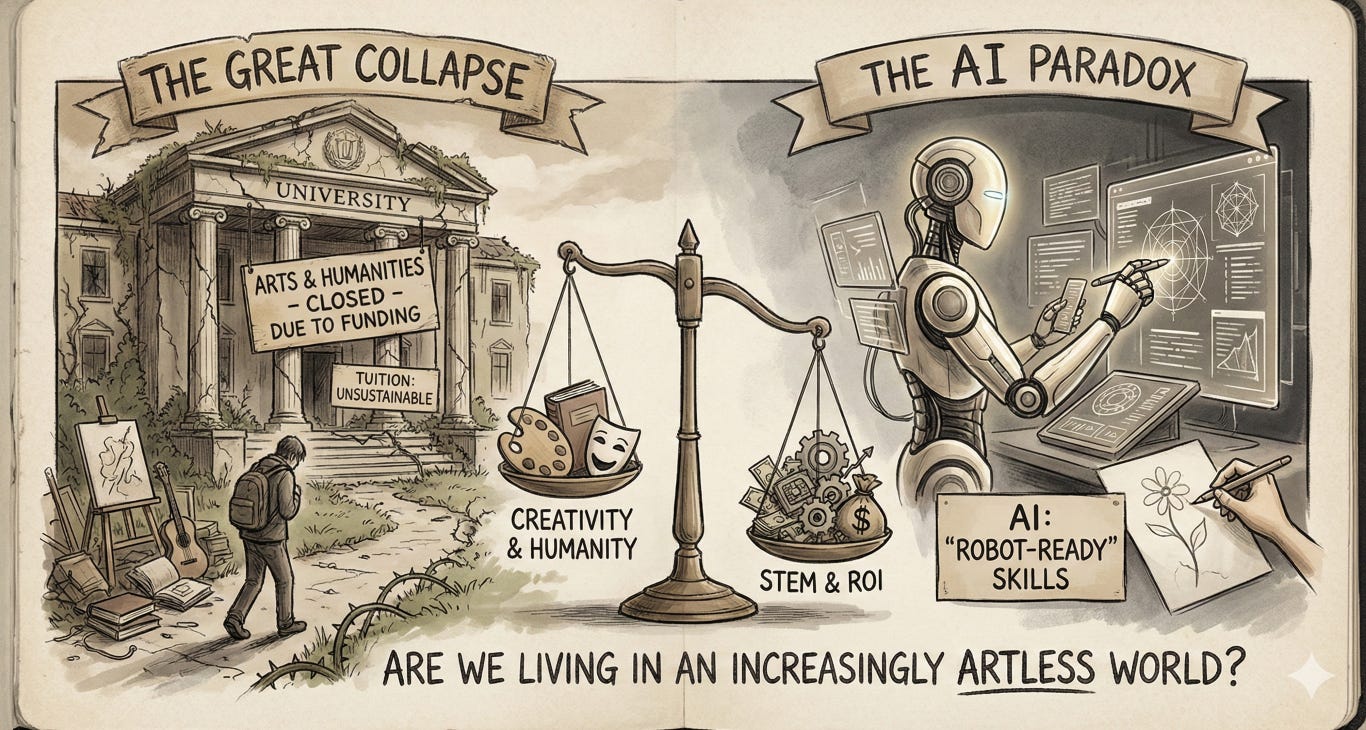
We are witnessing a quiet but catastrophic shift in how we prepare for the future. Just as Artificial Intelligence begins to master the technical and the rote, we are systematically dismantling the education of the one thing machines cannot yet authentically replicate: human creativity.
The Great Collapse
A new report from The Guardian this week has sounded a national alarm: Australia is in danger of becoming an “artless country”. Enrolments in creative courses have collapsed, universities are axing dozens of degrees, and the pipeline of future artists is drying up at the high school level.
The numbers emerging from the Australian education sector are stark. Since the introduction of the “Job-ready Graduates” scheme in 2021, a policy designed to steer students toward “practical” industries by doubling the cost of humanities degrees, the result has been a bloodletting.
Sky-high fees: Arts, society, and culture degrees saw student contributions rise by 116%. In 2026, a visual arts student pays nearly double what a math student pays ($9,537 vs $4,738), while a humanities student pays a staggering $17,399 per year.
Pipeline failure: The rot starts early. Year 12 enrolments in drama are down 39%, dance down 38%, and media down 25% over the last eight years.
Institutional retreat: Universities, facing funding shortfalls, have cut 48 creative degrees since 2018. Major institutions like ANU and Macquarie are slashing creative departments.
This is a “rollercoaster decline” that experts warn will lead to a “real reduction in the capacities to sustain a creative and cultural workforce” within five years.
But this isn’t just an Australian problem; it is a global one.
United States: The share of humanities degrees has dropped by nearly 30% since 2005, with departments facing elimination across the country.
United Kingdom: Government funding for arts courses has been slashed under claims they are “low value,” leading to a massive decline in students studying creative subjects.
The Survival Calculation
Why is this happening? It is the economy.
When rent and grocery prices soar, education becomes a financial risk calculation. Students (and their parents) are prioritizing immediate Return on Investment (ROI). The “safe” bet is STEM (Science, Technology, Engineering, Math). The “luxury” bet is the Arts.
As Professor Sandra Gattenhof notes, “There’s a disincentive for students to go into these areas and it’s not like they are big money-making areas”. The policy has created a price signal that tells students: Creativity is too expensive for you.
The AI Paradox
Here is the great irony: we are aggressively pivoting education toward technical STEM skills at the exact moment AI is proving it can do technical work faster, cheaper, and often better than entry-level humans.
We are training students to be “Robot-Ready”, competent at tasks machines will soon dominate—while discouraging them from becoming “Human-Ready.”
Recent reports from 2025 paint a different picture of the future job market:
The “Hybrid” Premium: Analyses of millions of job ads show that AI is increasing the demand for creativity. Employers are seeking “hybrid” workers who can guide AI tools with human critical thinking and emotional intelligence.
The “Grey Goo” Trap: As AI generates more of our content, we risk a world of “bland imitation” or “cultural atrophy.” Without trained human artists to push boundaries, our culture risks becoming a feedback loop of average, algorithm-generated noise.
By making creative education expensive and inaccessible, we are dismantling the very skill set that will command a premium in the 2030s: deep, critical, and emotional creativity.
Are we living in an increasingly artless world?
Based on the trajectory outlined in this report, the answer is yes.
Dr. John Nicholas Saunders warns that if current trends continue, “we risk limiting who has access to arts learning... We risk becoming an artless country”.
This isn’t just about a shortage of actors or painters. It is about a “hollowing out” of the workforce. If we sever the pipeline of talent, we lose the designers, architects, and storytellers who power the creative economy.
Furthermore, if arts degrees remain prohibitively expensive, we return to a 19th-century model where creativity is the preserve of the wealthy, silencing the diverse voices that drive true innovation.
The Way Forward
We need to stop viewing arts education as a luxury item for the idle and start viewing it as essential mental infrastructure for the AI age.
Policy Reform: The “price signal” method of hiking fees for arts degrees has failed to produce better job outcomes; it has only punished students. Governments must reverse these punitive fee structures.
From STEM to STEAM: We need to reintegrate Arts into STEM. The coders of the future need to understand ethics and narrative; the artists of the future need to understand algorithms.
Valuing “Soft” Skills: The job market is already signalling that “soft skills”, communication, empathy, adaptability, re the new “hard skills.” Our education system needs to catch up.
We are building a future full of incredibly smart machines. It would be a tragedy if we forgot to build smart, creative humans to guide them.
Keep creating,
Michal Plis
💬 Join the Conversation
I’d love to hear your thoughts on this. Please leave a comment below!
Is an Arts degree a bad investment? With the cost of living so high, is it irresponsible to encourage young people to study creative fields, or is it more necessary than ever?
The AI Factor: Do you believe AI will replace creative jobs, or will it make human creativity more valuable?
The Class Divide: Are we moving back to a world where only the wealthy can afford to be artists? What does that mean for the stories we tell as a society?
Your Experience: Have you or your children been discouraged from pursuing creative subjects in school recently?
References
The Guardian: Australia in danger of becoming an ‘artless country’... Link
Higher Education Policy Institute: The Humanities in Modern Britain Link
Pressenza: The decline of the humanities studies around the world... Link
Newcastle University: New Research Shows AI is Increasing Demand for Creativity Link
Creative Coach: Why AI Can’t Make Art Link