

When buying art, do we sometimes confuse physical size with artistic value? In a world where bigger houses, bigger cars and bigger products are often associated with success, it’s worth asking whether this mindset has influenced the way we appreciate and collect art.

Are oversized paintings genuinely better, or have we become accustomed to judging artworks by how much space they occupy rather than what they offer us? As an abstract artist who often works on a smaller scale, I'd like to explore what really makes an artwork worth collecting.
Obsession with bigger art
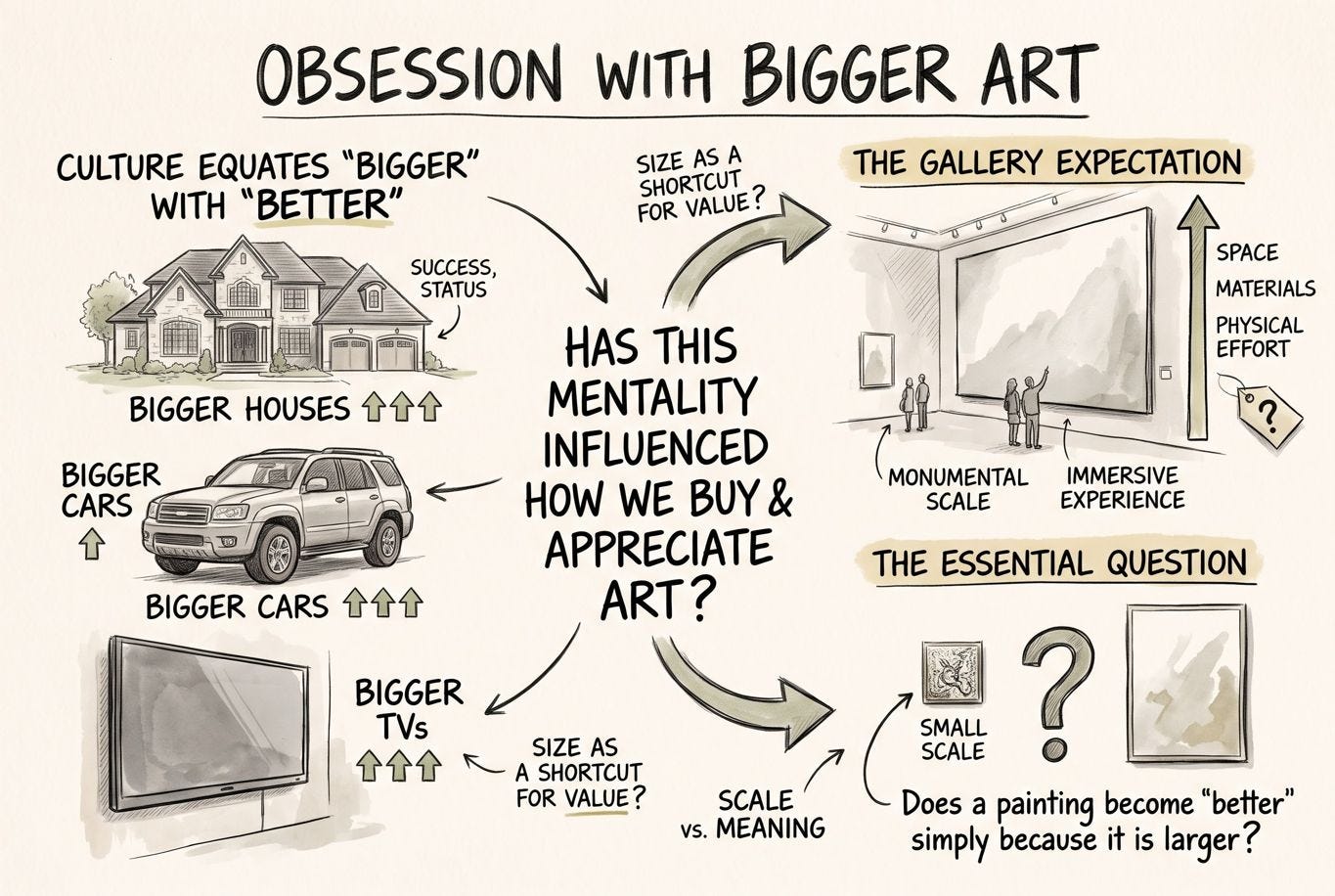
We live in a culture that often equates bigger with better.
Bigger houses, bigger cars, bigger televisions and bigger muscles are frequently presented as signs of success. In consumer culture, size can become a shortcut for judging quality, status and value.
Has this mentality influenced the way we buy and appreciate art?
Walk into some contemporary art galleries and you will encounter mostly enormous canvases, immersive installations and sculptures that occupy entire rooms. Such works can be extraordinary. Their scale can create an experience that a smaller work simply cannot reproduce.
But there is an important distinction between recognising the artistic possibilities of scale and assuming that a larger artwork is inherently better, more meaningful or more valuable.
Does a painting become better simply because the artist used a larger canvas?
And if we are buying art for our homes, should we be asking how much wall space it occupies, or what the work actually contributes to our lives?
Where does our fascination with size come from?
The idea that bigger is better is not exclusive to Western society, nor can it be attributed to a single cultural influence. Monumental art has existed across many civilisations for thousands of years.
Consider the enormous pyramids of ancient Egypt, monumental sculptures and the grand religious paintings commissioned by powerful patrons. Throughout history, scale has communicated authority, wealth, ambition and collective identity.
Large artworks can also serve practical purposes. A painting intended for a palace, public building or monumental church needs to be legible from a distance. Its dimensions are part of its function.
In modern times, consumer culture has added another dimension to this relationship between size and perceived value.
We are accustomed to comparing products through visible measurements: screen size, engine capacity, house size and the number of features included. It is easy to transfer this thinking to art, particularly when buyers are unfamiliar with evaluating artistic quality.
A larger painting may appear to offer more for the money. It occupies more space, uses more materials and may have required more physical effort.
But these observations do not establish that it is a better work of art.
The Western art market is also shaped by collectors, galleries, institutions, critics, interior designers and changing tastes. Some buyers actively seek monumental works, while others value intimate paintings, drawings and small sculptures.
The problem is not large art itself. The problem is using size as a substitute for judgement!
Leonardo da Vinci: A masterpiece does not need a monumental canvas
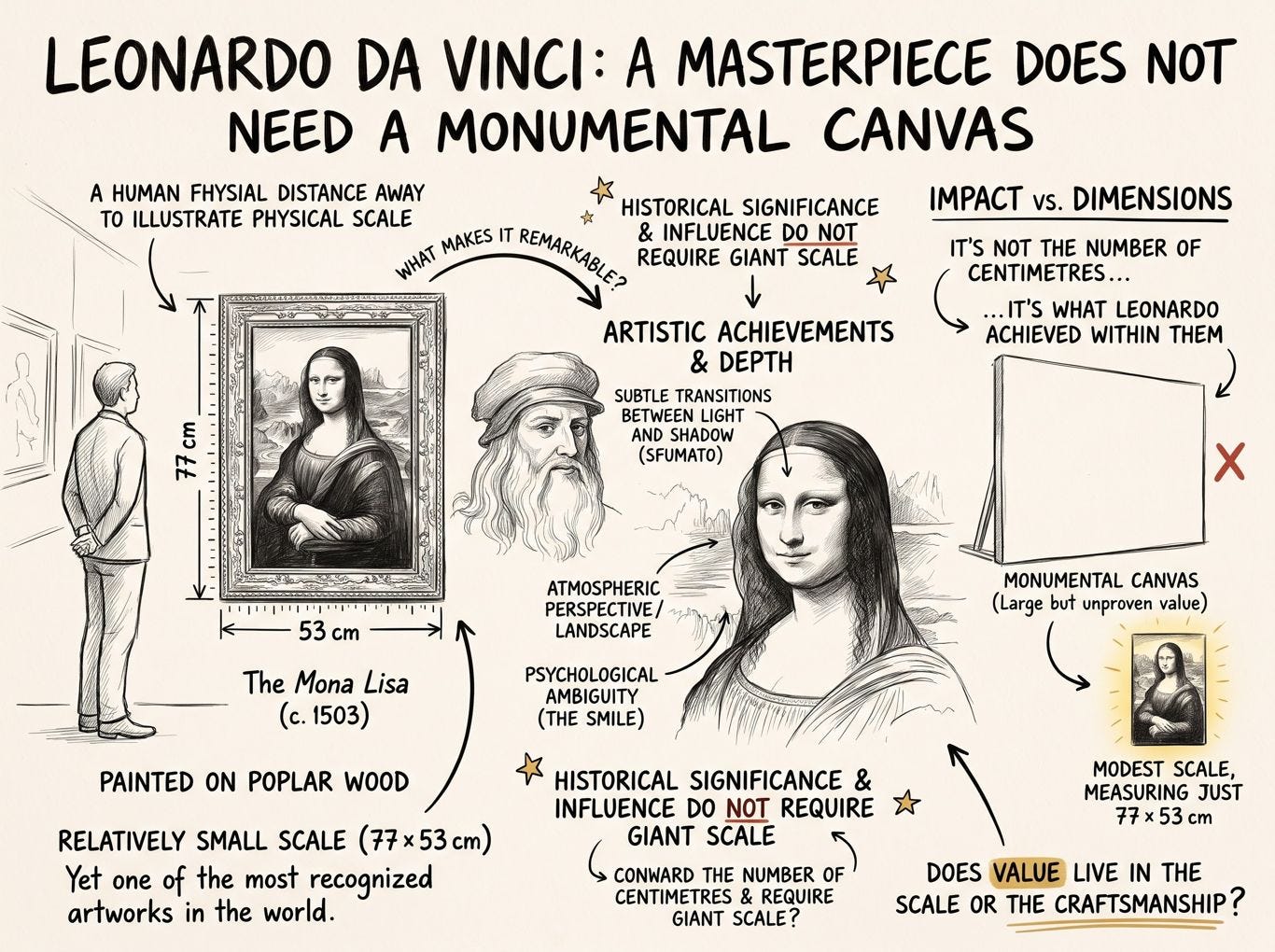
One of the most compelling historical examples is Leonardo da Vinci's Mona Lisa.
Painted on a poplar wood panel, the work measures approximately 77 × 53 centimetres. It is not a monumental painting, yet it has become one of the most recognised artworks in the world.
Leonardo is celebrated for his understanding of human anatomy, subtle transitions between light and shadow, atmospheric perspective and the extraordinary psychological ambiguity of the sitter's expression.
The painting's significance is not explained by its dimensions. Its artistic achievements, historical importance, royal provenance, cultural influence and subsequent history all contribute to its standing.
Leonardo began working on the portrait around 1503 and continued refining it over a period of years. It eventually entered the French royal collection and is now held by the Louvre in Paris.
Importantly, the Mona Lisa does not have a conventional contemporary market price. It is not regularly offered for sale, so we cannot honestly assign it a reliable auction value. Its cultural significance and the price a private buyer might theoretically pay are also different questions.
Nevertheless, it illustrates the central point of this article: a relatively small painting can achieve extraordinary artistic and historical importance.
It is not the number of centimetres that makes the painting remarkable.
It is what Leonardo achieved within them.
When small works command extraordinary prices
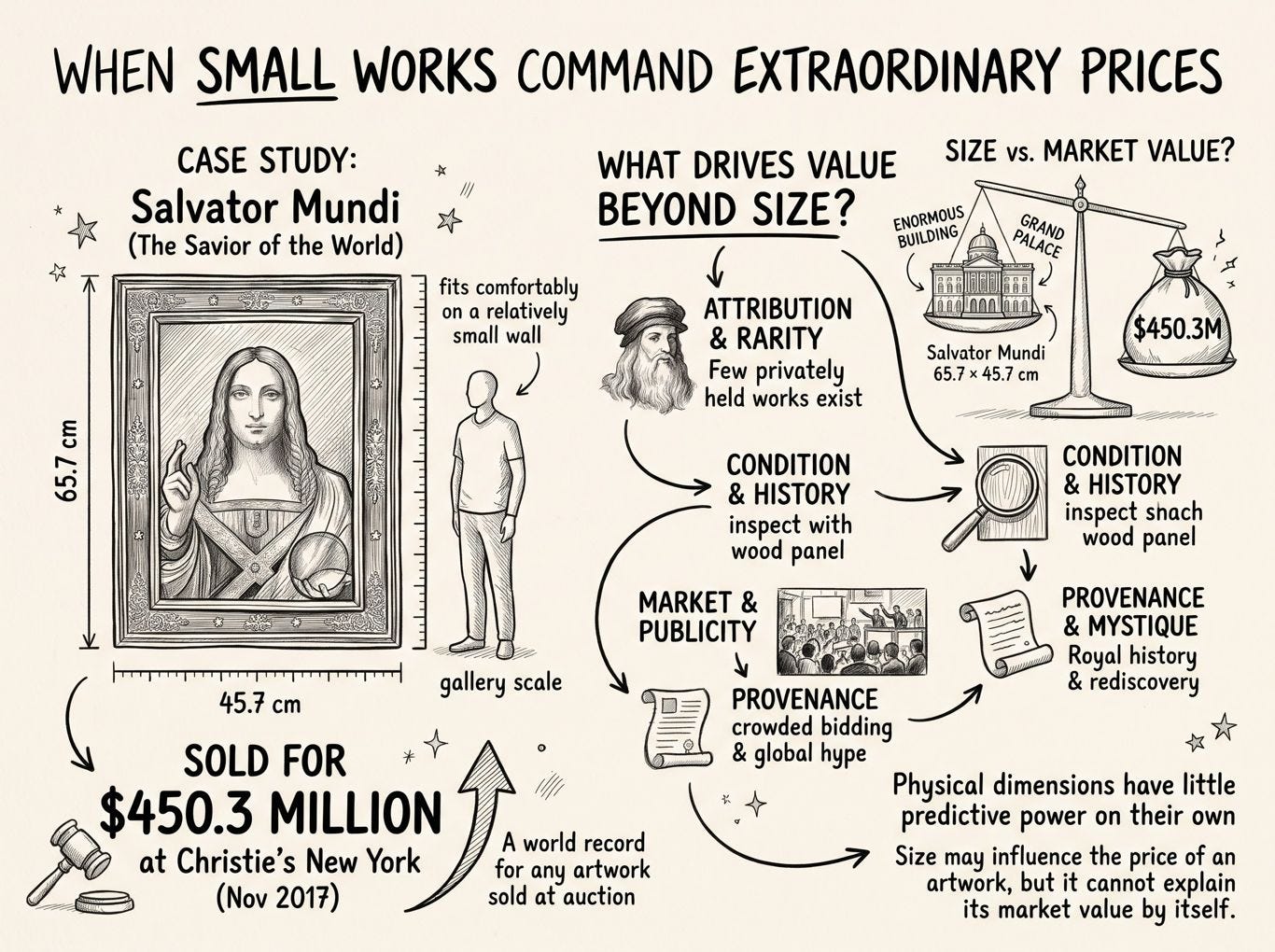
Another useful example is Leonardo's Salvator Mundi, a painting depicting Christ holding a crystal orb.
The painting measures approximately 65.7 × 45.7 centimetres. In November 2017, it sold at Christie's in New York for approximately US$450.3 million, setting a record for an artwork sold at auction.
That price requires context. The painting's attribution, condition, history, rarity, market circumstances and the intense publicity surrounding the sale all matter. Its auction price should not be interpreted as a simple measurement of artistic quality.
Nor does one exceptional sale establish what other small paintings should be worth.
However, the result demonstrates how little predictive power physical dimensions have on their own. A work that fits comfortably on a relatively small wall can command a price that exceeds the cost of enormous buildings.
Size may influence the price of an artwork, but it cannot explain its market value by itself.
What about artists who deliberately work on a large scale?
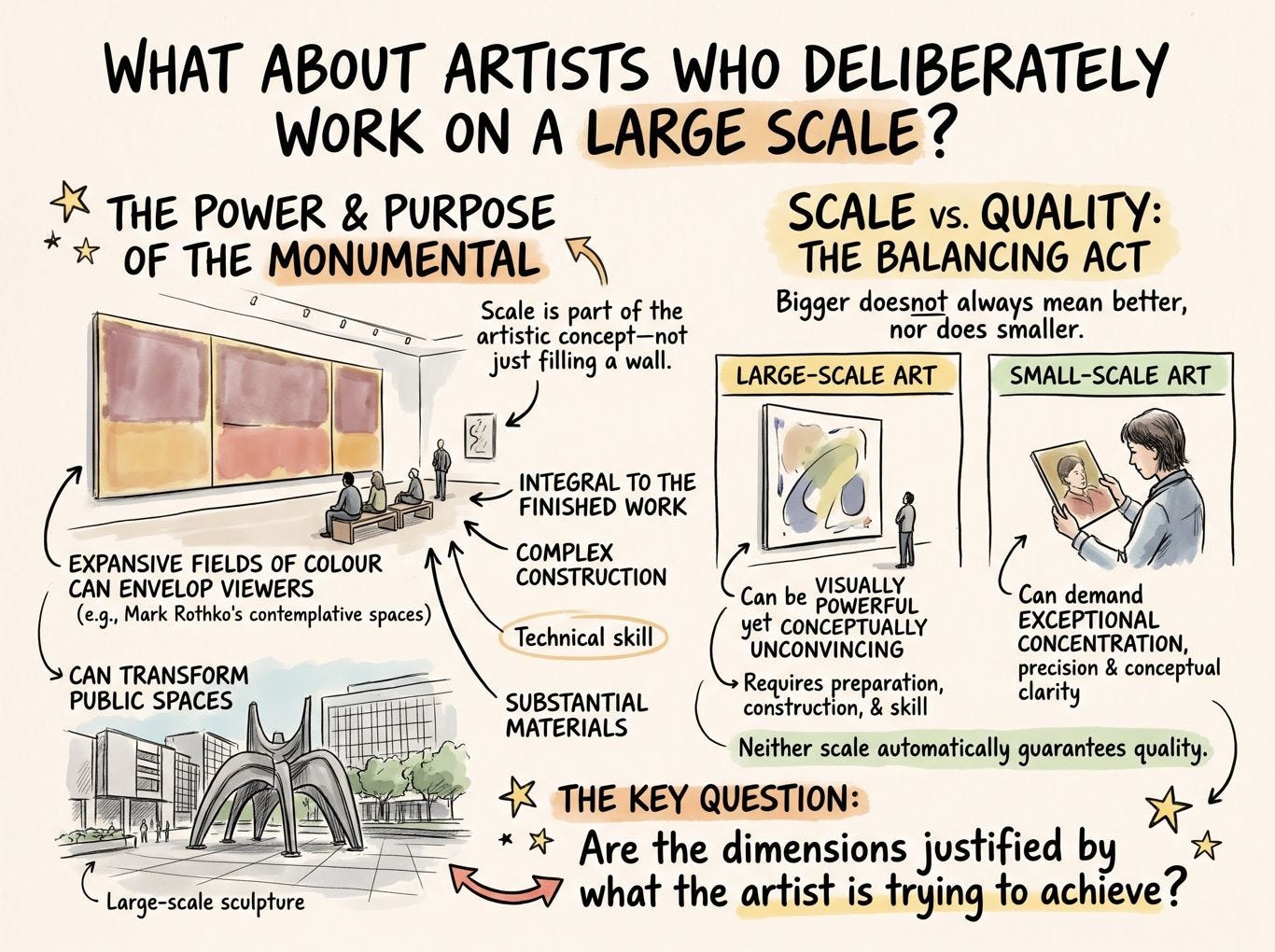
Large-scale art deserves serious consideration.
Artists such as Mark Rothko demonstrated how expansive fields of colour can envelop viewers and create a contemplative experience. Monumental sculpture, meanwhile, can transform public spaces and change how people experience their surroundings.
In these cases, scale is not merely a way of filling a wall. It is part of the artistic concept.
A large painting may require extensive preparation, substantial materials, complex construction and considerable technical skill. Its dimensions can be integral to the finished work.
But the same principle applies in reverse: a small artwork can demand exceptional concentration, precision, experimentation and conceptual clarity.
Neither scale automatically guarantees quality.
A large painting can be visually powerful yet conceptually unconvincing. A small painting can be subtle, innovative and emotionally affecting. The opposite can also be true.
The question should not be whether large or small art is inherently superior.
It should be whether the dimensions are justified by what the artist is trying to achieve.
Are we buying art, or decorating empty walls?

Interior design is a legitimate reason to purchase art.
A large painting can anchor a living room, establish a colour scheme or create a focal point. A small work may be better suited to a bedroom, study, hallway or carefully arranged collection.
There is nothing wrong with choosing art because it complements your furniture or fits a particular space.
Art lives in physical environments, and the relationship between an artwork and its surroundings can be important.
However, difficulties arise when interior design becomes the only consideration.
If the primary objective is to fill a large empty wall, the buyer may select a work mainly because of its dimensions. Artistic quality, originality and the significance of the work can become secondary.
The same can happen when buyers follow fashionable trends, such as heavily textured paintings, oversized abstract canvases or particular colour palettes.
Trends are not necessarily bad. Artists should be free to explore them, and collectors should be free to enjoy them. But popularity at a particular moment does not automatically establish lasting artistic importance.
A serious collector might ask:
Would I still want this artwork if it were half its current size?
Does it offer something beyond its decorative impact?
Am I responding to the artwork itself, or to the impression it creates in a room?
Would I still appreciate it if this particular style fell out of fashion?
These questions do not have predetermined answers. They encourage us to understand our own motivations.
My perspective as an artist
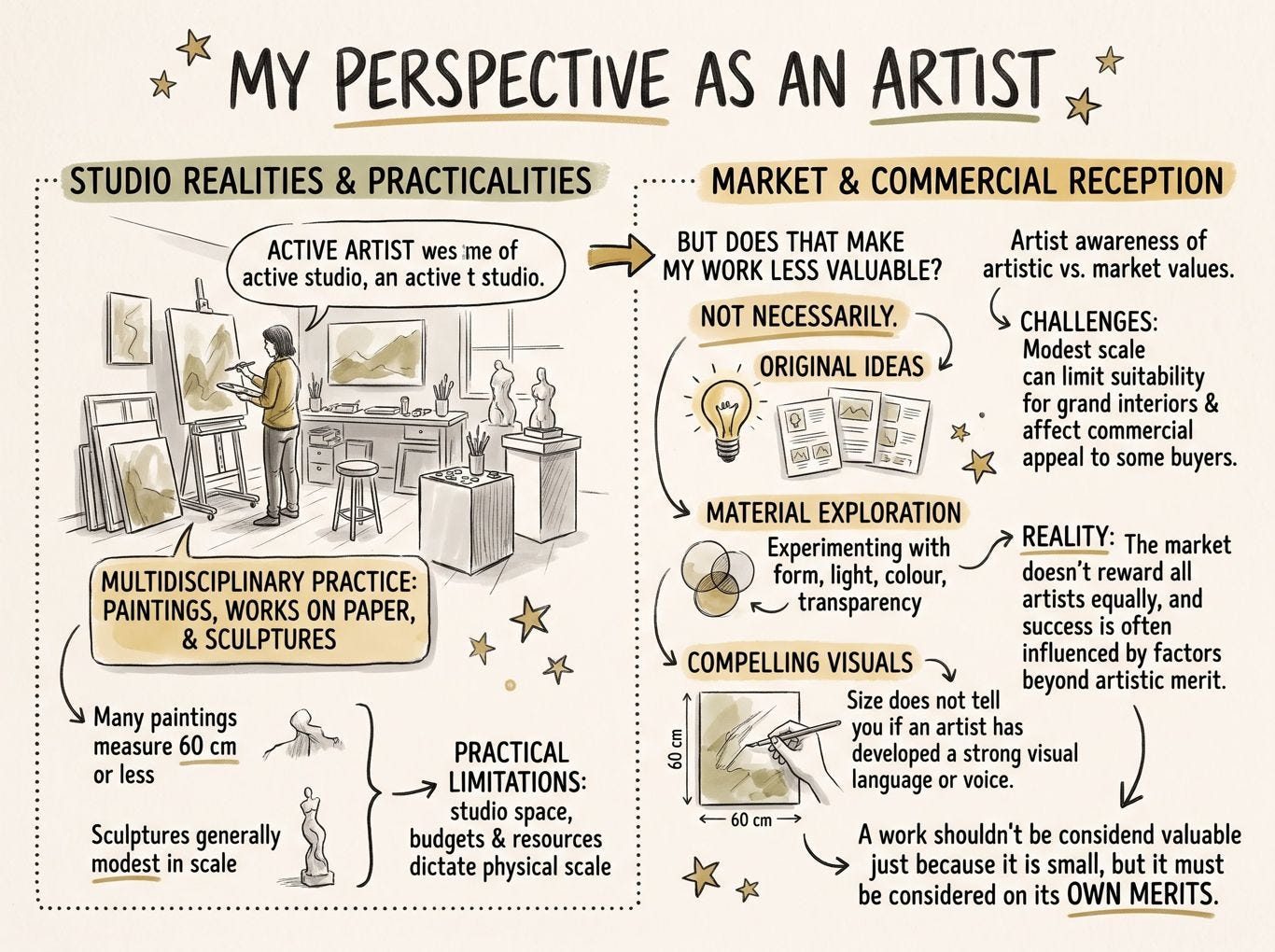
As a multidisciplinary abstract artist, I create paintings, works on paper and sculptures, often exploring form, light, colour, transparency and the relationships between different visual elements.
Many of my paintings measure 60 centimetres or less in width or height. My sculptures are also generally modest in scale.
Part of this is practical. My studio practice operates within budgetary constraints, and working on a smaller scale allows me to continue developing my ideas within the resources available to me.
But does that make my work less valuable?
Not necessarily.
The size of an artwork does not tell you whether the artist has developed an original idea, explored a material in an interesting way or created a compelling visual experience.
Of course, I recognise that making smaller works can limit their suitability for certain interiors and may affect their commercial appeal to some buyers. I also recognise that the market does not reward all artists equally, and that market success is influenced by factors beyond artistic merit.
I am not arguing that my work should be considered valuable simply because it is small.
Rather, I believe it should be considered on its own merits.
The same principle should apply to any artist, whether they create intimate paintings, monumental canvases or intricate sculptures.
An artwork's dimensions describe its physical size. They do not, by themselves, establish its artistic significance.
Maybe take a look at my art and my artist statement and my art and tell me as a collector is there anything worth considering? Visit michalplis.com
Now we got to figure out what do collectors actually look when acquiring artworks? And mind you, the list below may be more personal, but here's some suggested aspects to consider.
What should serious collectors look for instead?
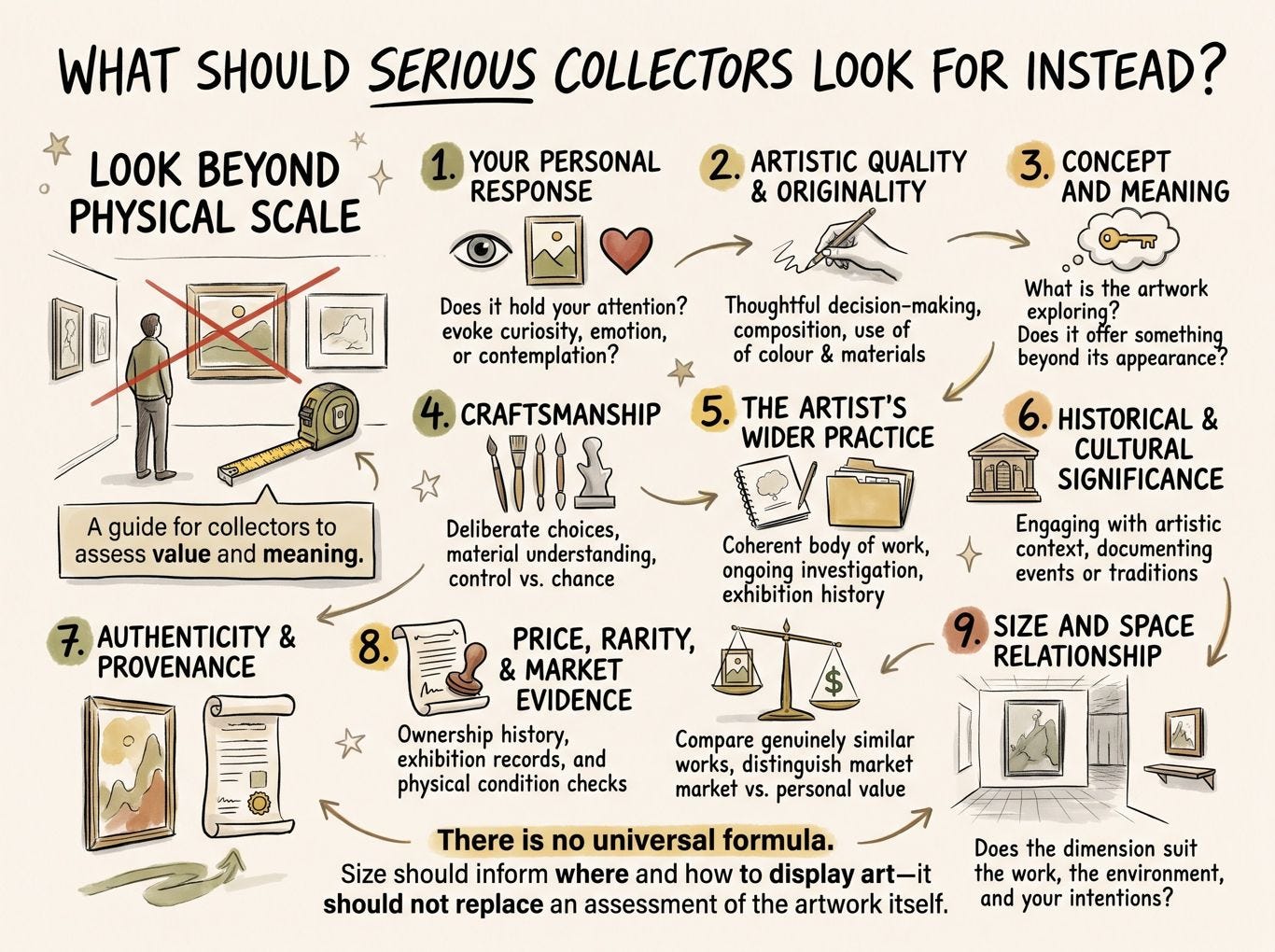
If size is not the primary measure of artistic quality, what should guide a purchase?
There is no universal formula for identifying good art. Artistic judgement involves experience, knowledge and personal response. Nevertheless, several well-established considerations can help collectors make more informed decisions.
1. Your personal response
Start with the artwork itself.
Does it hold your attention? Do you find yourself returning to it? Does it evoke curiosity, emotion, contemplation or a desire to understand it more deeply?
You do not need to be an academic or professional critic to respond meaningfully to art.
Personal connection is a legitimate reason to collect, even when you cannot immediately explain why a particular work appeals to you.
However, a strong initial reaction can be enriched by learning more about the artist and the work.
2. Artistic quality and originality
Look beyond the first impression.
Consider the composition, use of colour, relationships between forms, material choices, technique and the coherence of the work.
Does the artwork demonstrate thoughtful decision-making? Does it offer an interesting perspective? Does it develop an idea in a distinctive way?
Originality does not necessarily mean inventing something that has never existed before. Artists frequently build on historical traditions, reinterpret established techniques or develop ideas through sustained experimentation.
What matters is how convincingly the artist brings those elements together.
3. Concept and meaning
Ask what the artwork is exploring.
It might investigate identity, nature, memory, perception, technology, spirituality or the properties of materials themselves.
Not every artwork needs an elaborate explanation. Some works are primarily concerned with visual experience, while others communicate ideas through symbolism, narrative or experimentation.
A useful question is whether the work offers something beyond its immediate appearance.
Does understanding its concept deepen your appreciation, or does the explanation seem disconnected from what you can actually see?
4. Craftsmanship and material understanding
Consider how the work has been made.
Are the materials appropriate for the artist's intentions? Does the technique support the result? Has the artist demonstrated control, experimentation or an inventive approach to the medium?
Craftsmanship does not always mean polished or technically perfect execution. Deliberate roughness, chance, imperfection and material unpredictability can all be meaningful artistic choices.
The important consideration is whether the execution serves the work.
5. The artist's wider practice
Look at other works by the artist.
Does this artwork fit within a coherent body of work? Does it reveal an ongoing investigation or a significant development in the artist's practice?
An isolated work can be excellent, but understanding the artist's broader practice may help you recognise what makes it distinctive.
Exhibitions, publications, critical writing and inclusion in recognised collections can provide useful context. They are evidence to consider, not automatic proof that a work is good.
6. Historical and cultural significance
Some works become important because of the period in which they were made, the ideas they introduced or the cultural conversations they influenced.
Others preserve a particular tradition, document an event or offer insights into the society in which they were created.
Historical importance can contribute to an artwork's significance independently of its physical dimensions.
For contemporary art, it is also worth considering whether the work engages meaningfully with its artistic context.
7. Authenticity, provenance and condition
These factors are especially important when purchasing art with substantial financial value.
Provenance refers to an artwork's documented ownership history. Exhibition records, publications and other documentation may help establish its history and authenticity.
Condition matters because damage, deterioration and certain restoration treatments can affect an artwork's integrity and market value.
For expensive works, seek appropriate documentation and independent professional advice where necessary. Do not rely solely on a seller's claims.
These checks are particularly important if you are considering art partly as a financial investment.
8. Price, rarity and market evidence
Artistic significance and financial value are related, but they are not identical.
An artist's reputation, collector demand, rarity, exhibition history and previous comparable sales can all influence price.
A rare work is not automatically desirable, and a high asking price does not prove that an artwork is worth that amount.
When assessing price, compare genuinely similar works by the same artist, taking account of medium, dimensions, date, condition and sales history.
Be careful about treating auction records as direct comparisons with gallery prices, which may reflect different circumstances and services.
Most importantly, distinguish between what you personally value in an artwork and what the market might pay for it later.
9. The relationship between size and space
Size still matters when it serves a clear purpose.
A monumental painting may be ideal for a spacious room, while a small sculpture might reward close observation on a shelf or pedestal.
You may also choose to collect several smaller works and arrange them together, creating a relationship between individual pieces.
The question is whether the dimensions suit the work, the environment and your intentions as a collector.
Size should inform the practical decision of where and how to display art. It should not replace an assessment of the artwork itself.
So, is size important when buying art?
Yes, but its importance depends on what you are trying to achieve.
If you need a painting to occupy a particular wall, its dimensions are a practical consideration. If you are purchasing a sculpture for a small apartment, its physical footprint may be essential.
But if you are trying to understand an artwork's artistic merit, historical significance or potential market value, size is only one variable among many:
The mistake is not buying large paintings.
The mistake is assuming that large paintings must be better.
Nor should small works automatically be considered superior because they are more intimate, affordable or demanding to produce.
Every work deserves to be assessed individually.
A final thought for collectors
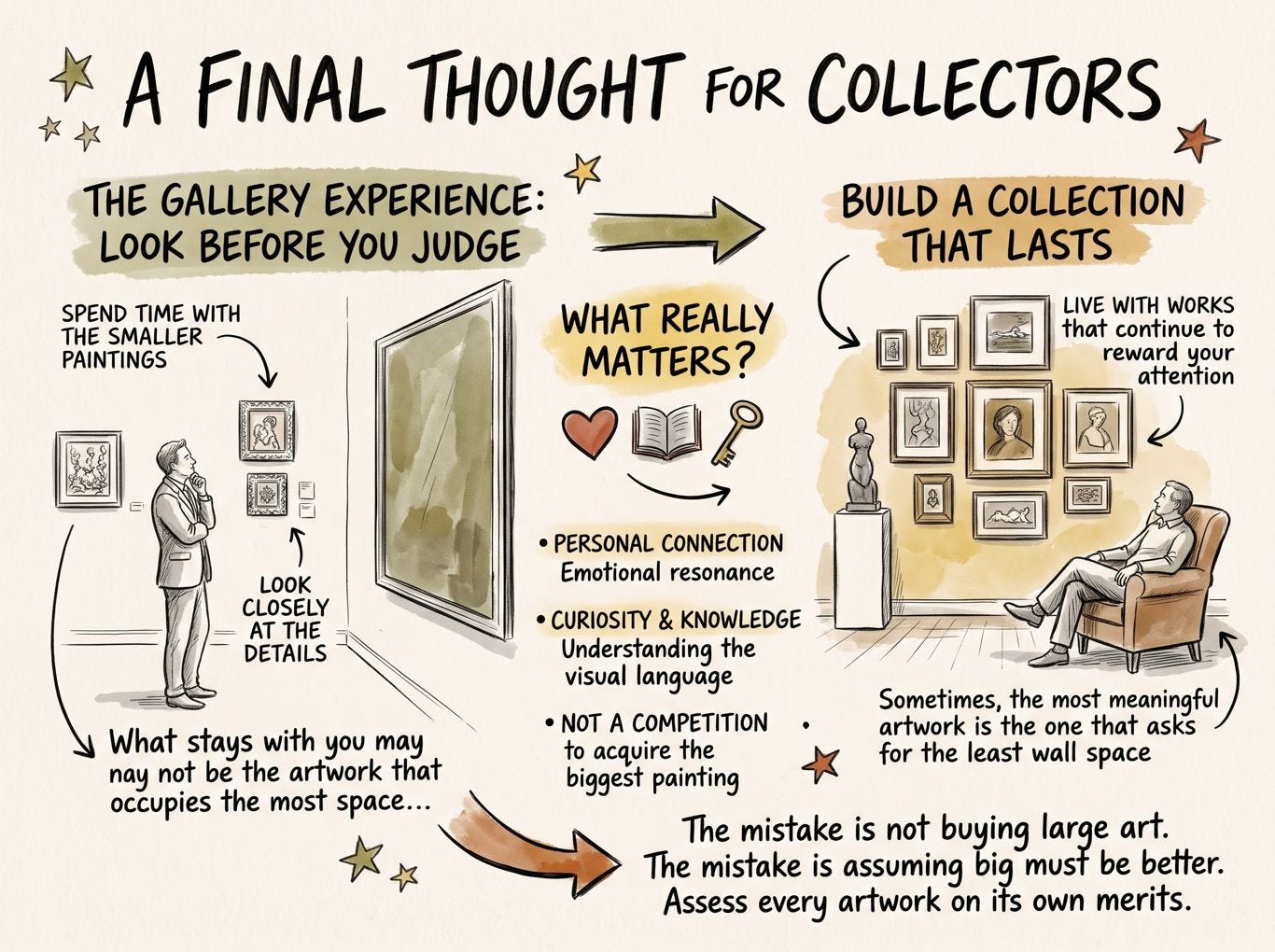
The next time you visit an art gallery, try looking at the artworks before considering their dimensions or prices.
Spend time with the smaller paintings. Look closely at the details. Consider the relationships between forms, the artist's choices and the ideas that emerge as you observe the work.
Then compare your experience with that of the larger pieces.
You might discover that the artwork that stays with you is not the one that occupies the most space.
It may be the one that makes you think, feel or see something differently.
As a collector, you do not need to impress other people with the size of your collection or the scale of the works on your walls.
You can build a collection around curiosity, knowledge, personal connection and a genuine appreciation of artistic practice.
Art collecting is not a competition to acquire the biggest painting. It is an opportunity to live with works that continue to reward your attention.
And sometimes, the most meaningful artwork is the one that asks for the least wall space.
Happy collecting and warm regards
Michal Plis
Melbourne abstract artist