

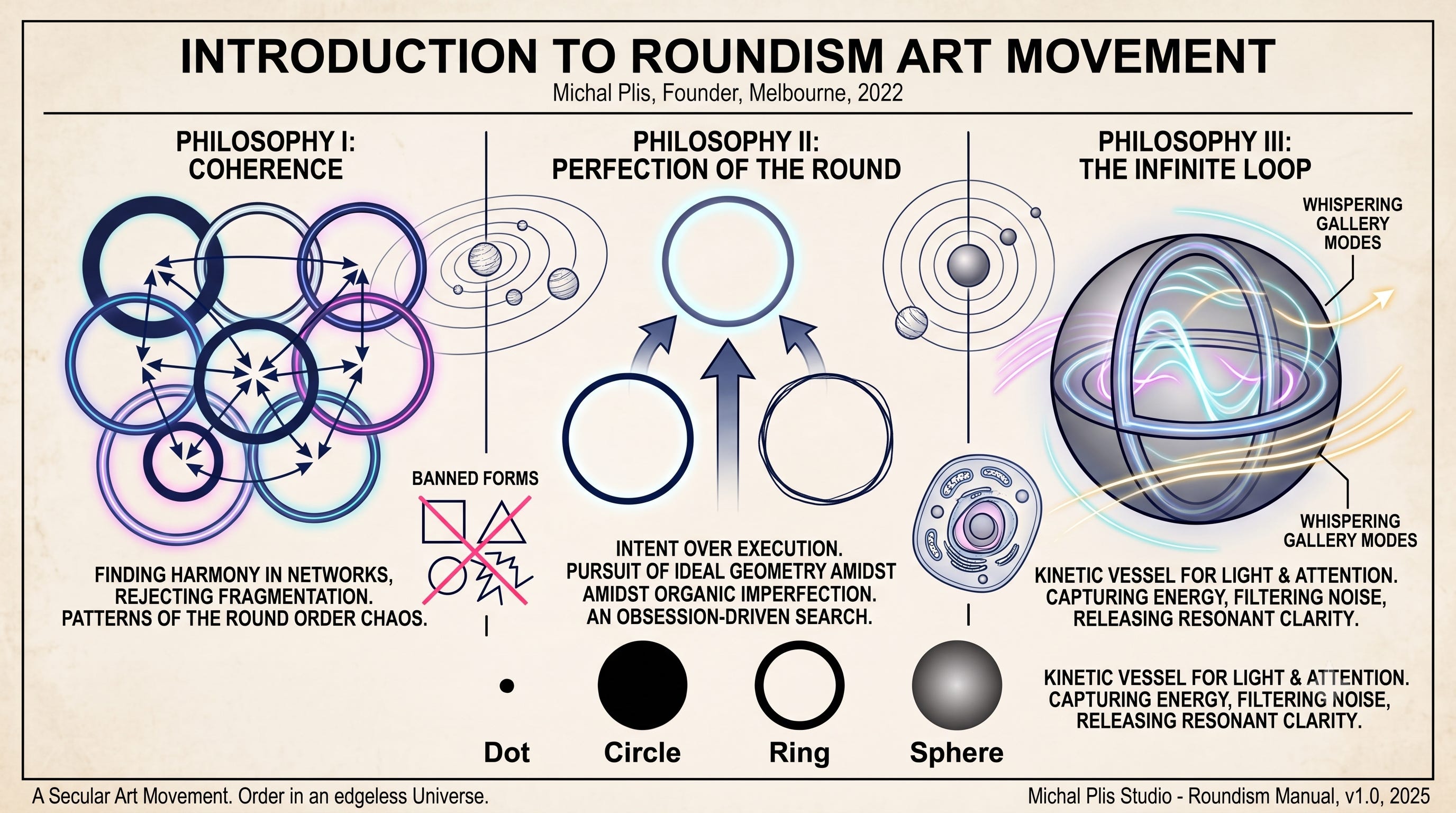
Conceived in Melbourne in 2022 by Michal Plis (me), Roundism is a contemporary, secular art movement that interprets the universe and human experience through a strict visual grammar of completely round, edgeless forms. Inspired by nature and established art principles, it explores the universe and ourselves using only completely round, edgeless forms: dot, circle, ring, and sphere.
This manual serves as the foundational introduction to the movement, tracing its philosophical pillars, historical context, scientific overlaps, and studio techniques. By establishing a rigorous standard of order, Roundism offers a fresh methodology for finding visual unity in a fragmented world.
I officially released this movement to the public on November 15, 2025, at the launch of my solo exhibition, Glimpse of Another Universe, held at the Louis Joel Gallery in Altona, Victoria. This launch represented the culmination of years of daily observation, art historical research, and deep material experimentation in my studio. By defining this shared geometric grammar, my goal is to invite other artists to explore this universal language, whether through abstract or figurative paths.
For the full roundism manifesto released in the exhibition in 2025, you can visit the Roundism Manifesto page here.
My Return to Art

My journey into the fine arts is rooted in a deeply personal history of creative restoration and grief. I was introduced to the creative world as a child by my late mother, Renata Plis, an accomplished painter, sculptor, and darkroom photographer who studied in Koszalin, Poland. She worked across diverse mediums, including oil paints, acrylics, clay, textiles, and traditional darkroom photography. Following her tragic passing when I was only three years old, her artistic legacy was largely lost to time, leaving only a few surviving paintings scattered in private homes. This early loss established a deep lesson in my heart: time is an enemy of art, and beautiful, human-made creations are easily lost if they are not actively protected and preserved.
This lesson was reinforced years later in Melbourne. During the COVID-19 lockdowns, another artist with whom I shared a storage space unilaterally discarded my entire collection of oil paintings, tools, and materials during a house move. Dealing with this loss felt like holding a mini funeral in my heart for my lost creations. But it taught me a vital lesson: keep making art, and never store your work with anyone else.
Following a twelve-year gap in my studio practice, during which art remained a entirely private pursuit, I returned to my creative roots in 2022 with a renewed, singular purpose. Through art therapy, I confronted the long-standing grief of my mother’s passing, visualizing a perfect future day where I would see her again, waiting for me on a bench. This visualization became a creative engine, driving me to return to school.
Since 2024, I have been refining my technical skills at the Melbourne Studio of Art under the mentorship of accomplished sculptor Ilona Herreiner. My highly disciplined technical background, combined with a neurodivergent perspective, shifted my focus toward sculpting with light and developing multispectral works that physically interact with their environments. Today, my studio in Mount Waverley, Victoria, serves as the active testing ground for the principles of Roundism, a movement I conceptualized by closely studying art history, observing the flawless circular patterns in nature, and experimenting relentlessly with light-reactive materials.
Structural Definitions
To understand Roundism, we must first establish the specific vocabulary of the movement:
Roundism: A structured, secular art movement and set of principles used to interpret the world in either a figurative or abstract way, utilizing general art principles alongside strict, movement-specific laws.
Completely Round: Having a continuous, uniform, and never-ending boundary. In geometry, an edge is defined as a line segment connecting two vertices in a polygon. Because the round forms of this movement do not have vertices, corners, or straight-line segments, they are mathematically defined as edgeless forms.
Roundish: Exhibiting contours that suggest the round without completing a full loop. Half-circles, half-rings, and half-spheres are considered roundish and are accepted within the movement.
Abstract Roundism: Utilizing the four allowed forms to invent compositions that do not represent objects from the physical world, capturing instead the hidden pathways of the subconscious and the unknown.
Figurative Roundism: Utilizing the same strict, round forms to represent real-world objects, from microscopic cells to massive planetary systems, showing that the physical world is fundamentally constructed of edgeless shapes.
What Roundism Is (And Is Not)
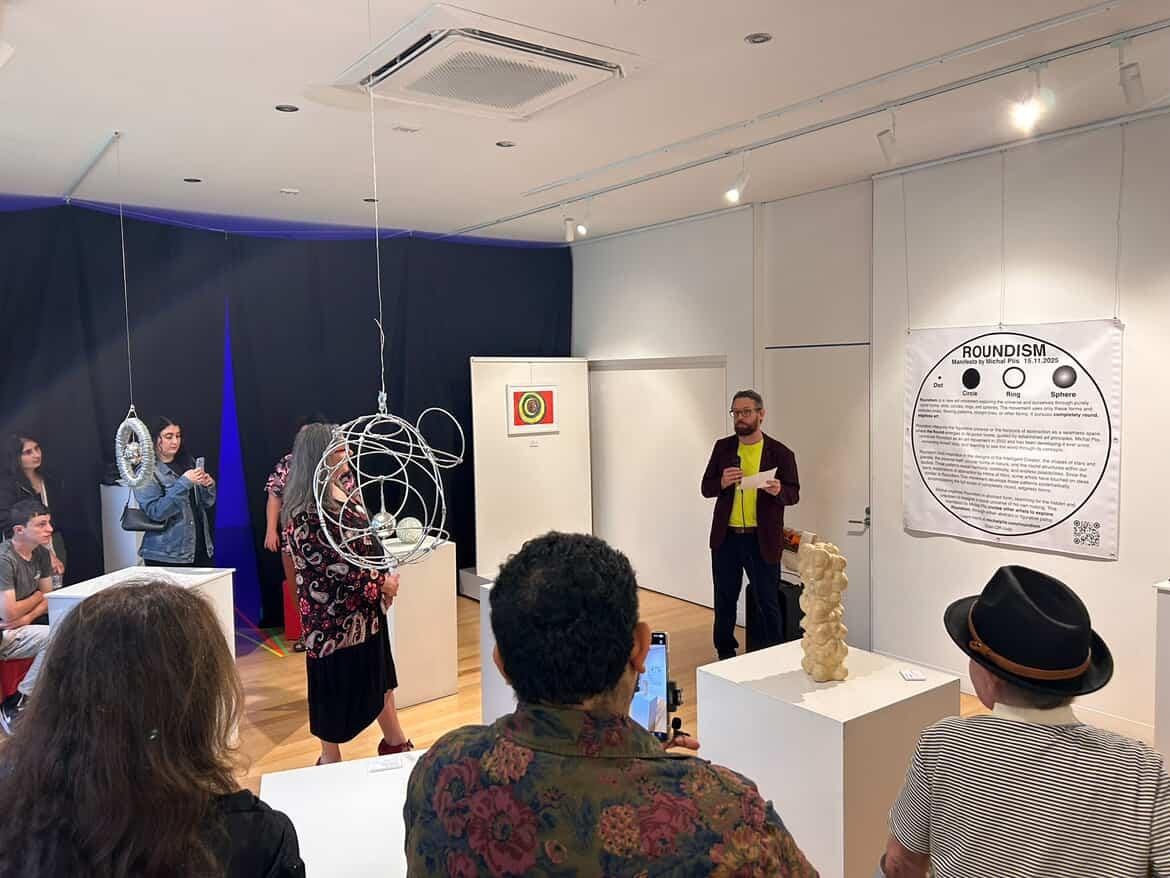
During the launch event of my solo exhibition, Glimpse of Another Universe, in late 2025, several engaging dialogues arose regarding how this movement positions itself within contemporary art. To maintain the purity of our focus, we must draw clear distinctions:
This Roundism is not the personal figurative style of Dutch painter Corne Akkers, which fractures human subjects into cubist, semi-curved planes.
It is also distinct from the conceptual writings of Terry Long on spiralism or squareism.
Instead, our movement is a highly disciplined, structured, and collaborative collective. We are dedicated to a shared geometric grammar that completely eliminates the corner, the straight line, and the erratic fragment in order to reveal the underlying coherence of reality.
For a more detailed definition you can visit the Roundism Definitions website page here.
A Crucial Note on Secularism
Roundism is a secular art movement. While my own studio practice is deeply sustained by my personal faith in an Intelligent Creator and the elegant order of the cosmos, the movement itself is strictly non-doctrinal and secular.
We separate our shared visual vocabulary from any specific theological, metaphysical, or historical beliefs. Roundism belongs to no single faith; it is an open, universal visual language designed to connect human minds across cultural, national, and intellectual boundaries.
The Core Principles and Allowed Forms
The visual language of Roundism is uncompromising. The movement strictly prohibits the use of ovals, straight lines, corners, rectangles, triangles, or any organic flowing shapes that veer off a true circular path.
Ovals are excluded because they stray from a uniform radius, losing the perfect symmetry of the round. Straight lines and corners are rejected because they represent points where visual energy is abruptly stopped, creating a geometry of division.
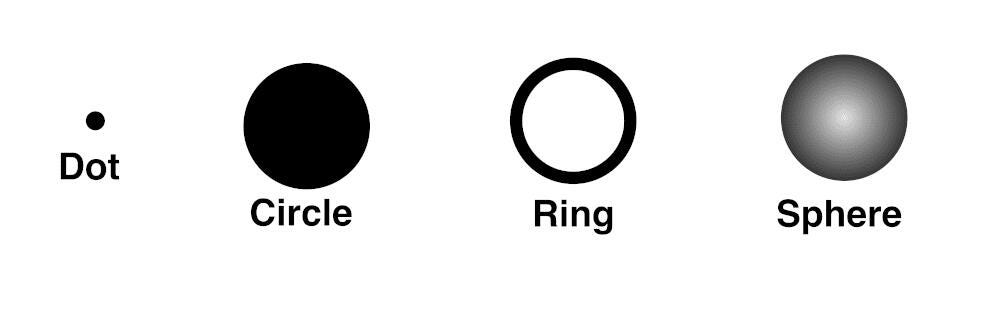
The movement relies entirely on four allowed geometric forms:
The Dot: The smallest round mark or single point in space. It represents the ultimate seed of beginning and the point of final conclusion.
The Circle: A two-dimensional round form of uniform radius, representing an unbroken, infinite boundary.
The Ring: A smaller circle nested perfectly inside a larger circle, doubling the edgeless path.
The Sphere: A three-dimensional completely round object, representing a flawless, isotropic vessel of space.
For additional Roundism principles visit the Roundism Core Principles page here.
Three Foundational Philosophies
Roundism is built upon three conceptual pillars that bridge the gap between material physics and fine-art philosophy.
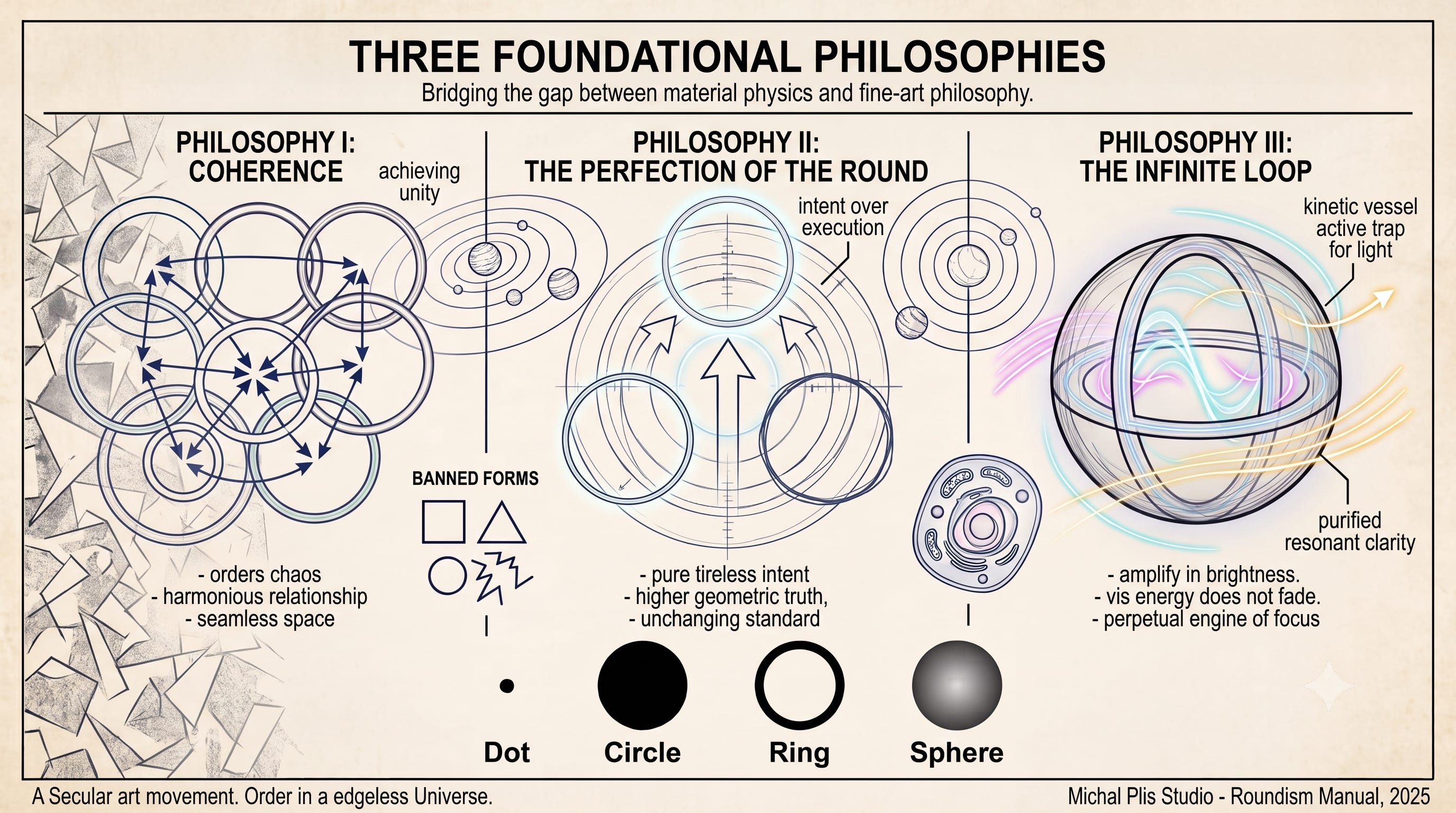
Philosophy I: Coherence
Coherence is the visual methodology of achieving unity. While historical movements like Cubism analyzed reality by shattering it into erratic, sharp-edged fragments, Roundism seeks to heal the image. Through patterns of the round, the movement orders chaos, focusing on the networking, layering, and connections between forms. By rejecting the corner, Roundism establishes a seamless space where all elements exist in harmonious relationship, mirroring the underlying order of the natural world.
Philosophy II: The Perfection of the Round
This philosophy addresses the relationship between pure geometry and organic execution. While the math of a circle is perfect, anything in the physical universe is technically imperfect. Materials have flaws, gravity warps space, and the human hand is inherently organic.
Roundism embraces the human condition. A perfectly round form made with a compass, laser cutter, or stencil, and an imperfect, hand-drawn round form that suggests a circle through its shaky, human line, are both valid. It is the pure, tireless intent toward the round that defines the work. This intent represents an obsession-driven search for a higher, unchanging geometric standard of order that transcends our chaotic reality.
Philosophy III: The Infinite Loop
A round form is not mere you a static shape; it is a kinetic vessel. Drawing on the physics of magnetism and Whispering Gallery Modes, where waves circulate along a curved boundary, a Roundist artwork acts as an active trap for light and attention.
In a linear painting, the viewer’s gaze often slides off the edge of the canvas. In a Roundist work, the circular forms exert a gravitational pull, capturing the viewer’s attention and forcing it to circulate in a self-sustaining orbit. Within this loop, visual energy does not fade, it amplifies. The artwork functions as a perpetual engine of focus, filtering out external noise and returning a purified, resonant clarity back to the observer.
For extra detail on the Roundism philosophies and to share with others you can also visit the Roundism Philosophies page here.
The Round in the Universe and Earth
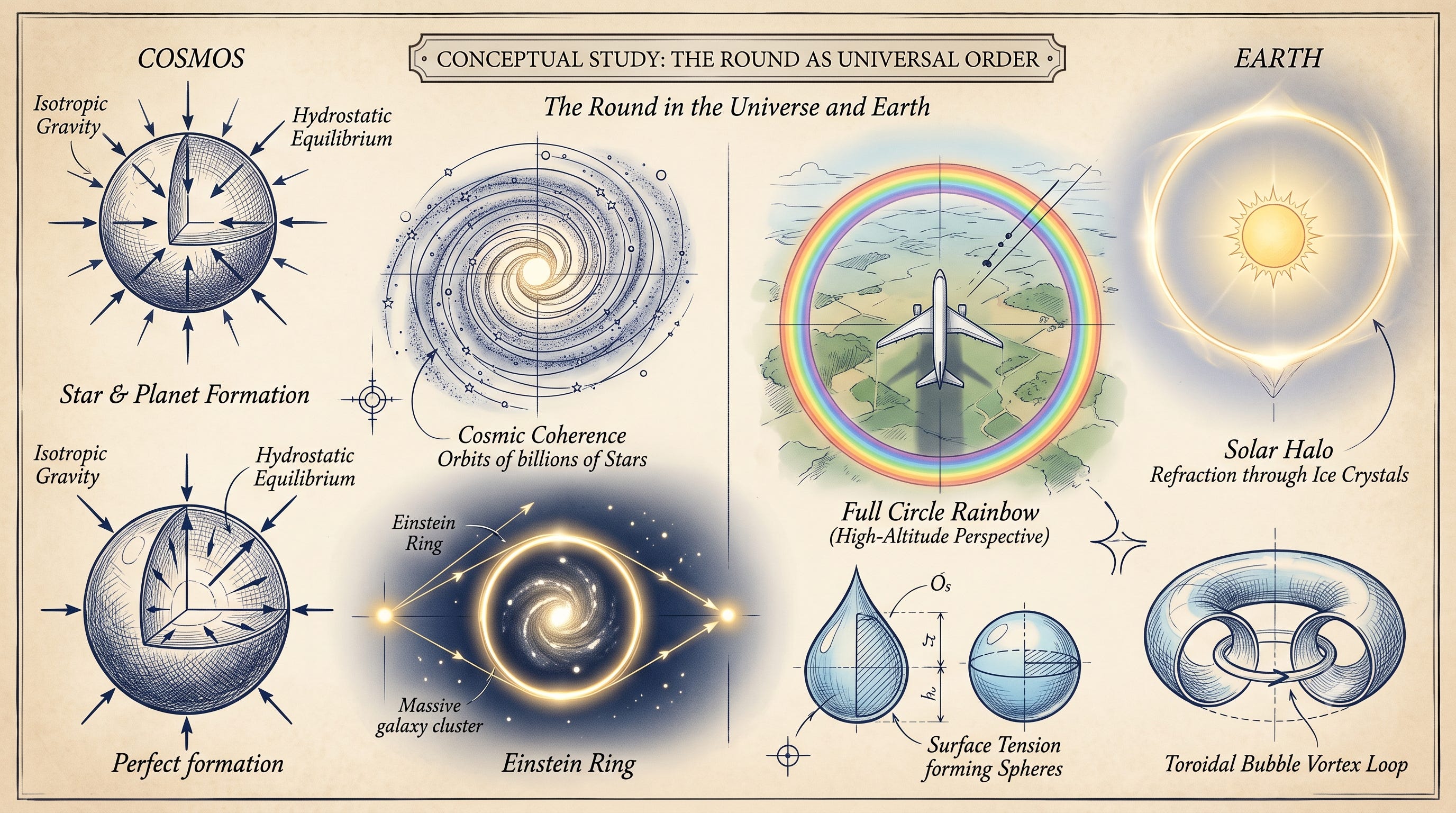
Roundism finds its deepest validation in the physical laws that shape the cosmos. When we observe reality at a macro level, we find that the universe is overwhelmingly round:
Cosmic Spheres: Stars and planets pull themselves into near-perfect spheres due to Isotropic Gravity, which pulls mass equally from all directions. This structural balance is maintained by Hydrostatic Equilibrium, where the inward collapse of gravity is balanced perfectly by outward radiation pressure.
Galactic Orbits: Over sixty percent of visible galaxies are spiral or elliptical. These giant systems utilize central gravity to order billions of stars into vast, circular orbits, demonstrating a cosmic scale of Coherence.
Einstein Rings: In deep space, gravity behaves as a natural lens. When a massive galaxy aligns perfectly in front of a distant light source, the intense gravitational field bends the light into a brilliant, circular ring, proving that even empty spacetime curves toward the round.
On our own planet, the water cycle and atmosphere display endless circular processes:
Circular Rainbows: While a viewer on the ground sees a rainbow as a half-ring, from a high-altitude airplane, the phenomenon is revealed as a complete, perfect circle. Sunlight refracting through uniform raindrops bends at precise angles, creating a circular screen of spectral colors centered on the observer’s shadow.
Solar Halos: When sunlight passes through high-altitude ice crystals in cirrus clouds, it creates a crisp, glowing ring of light at a precise angle, framing the sun in a natural golden boundary.
Fluid Dynamics: Toroidal bubble rings, or vortex loops, form underwater as air spins poloidally, locking the fluid into a self-sustaining circular structure. Tiny raindrops, measuring less than 1 mm in diameter, maintain a perfect spherical shape due to the intense pull of surface tension.
The Round in Life, Human Behavior, and Psychology
The edgeless form is deeply woven into our biology, our modern technology, and our subconscious behavior:
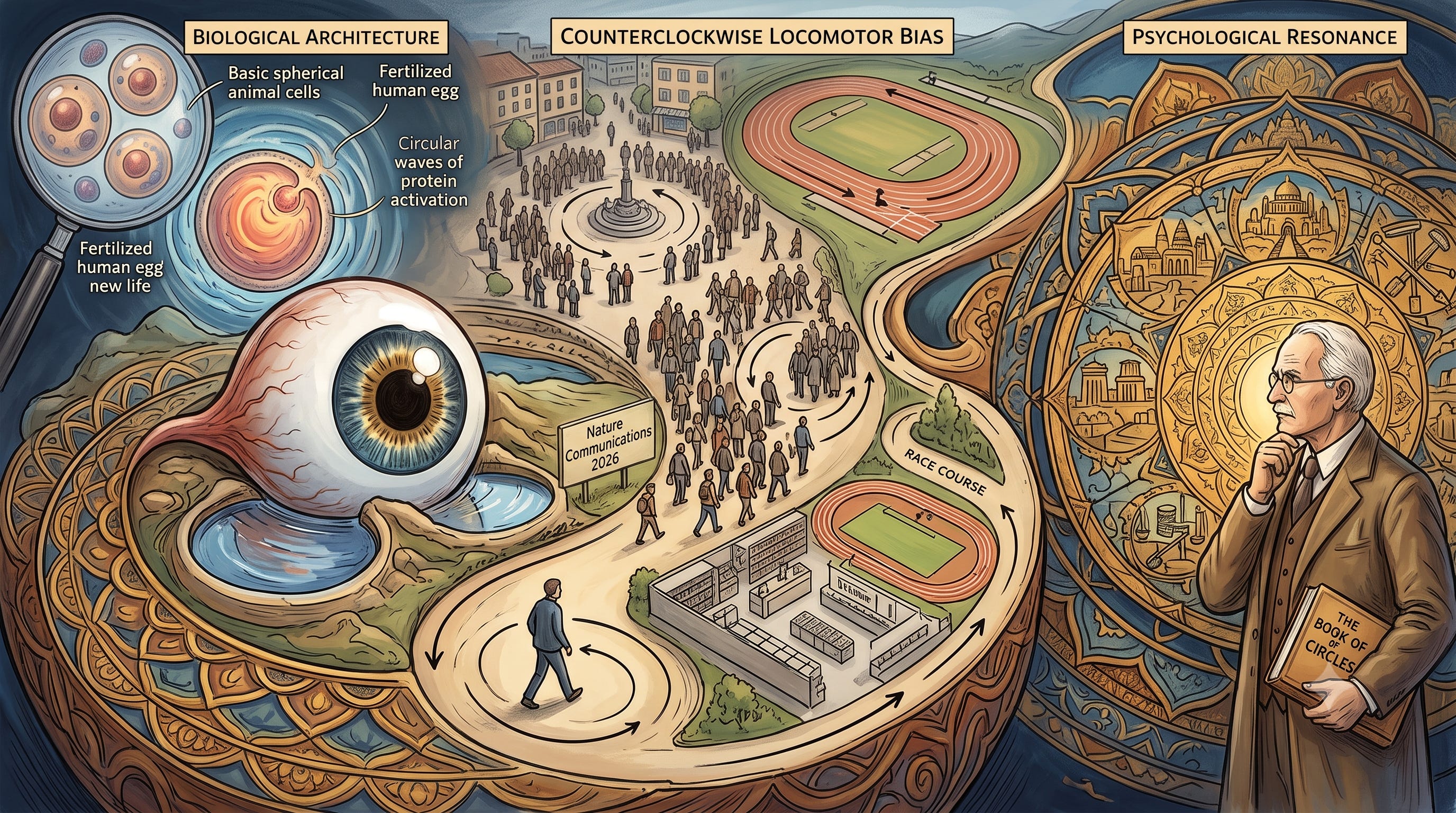
Biological Architecture: The basic building blocks of life, animal cells, are fundamentally spherical or elongated ellipsoids. At the moment of conception, the fertilization of a human egg triggers dynamic, circular waves of protein activation that ripple and spin across the outer membrane, signaling the start of new life. The human eyeball and iris are round, optimized for the collection, focus, and transmission of light.
The Counterclockwise Locomotor Bias: Human behavior is naturally circular. When lost, humans tend to walk in circles. More remarkably, a peer-reviewed paper entitled “Individual locomotor bias drives counterclockwise motion in pedestrian crowds” published in Nature Communications in 2026 highlights an intrinsic, biological bias in human movement. Across cultures, crowd flows in dense or sparse assemblies spontaneously organize into counterclockwise circular patterns. This intrinsic bias governs everything from athletic running tracks and race courses to the architectural layouts of modern supermarkets and public parks.
Psychological Resonance: The Swiss psychiatrist Carl Jung explored the profound impact of the circle in his work on mandalas, identifying them as universal representations of the self and psychological integration appearing across ancient cultures and human dreams. In his book, “The Book of Circles”, researcher Manuel Lima demonstrates that virtually every civilization has utilized the circular form as the chief organizing model to make sense of our world, shaping our cities, our tools, and our systems of knowledge.
Historical Lineage in the Arts
Roundism does not exist in isolation, it is the systematic culmination of an ancient artistic drive toward the edgeless ideal:
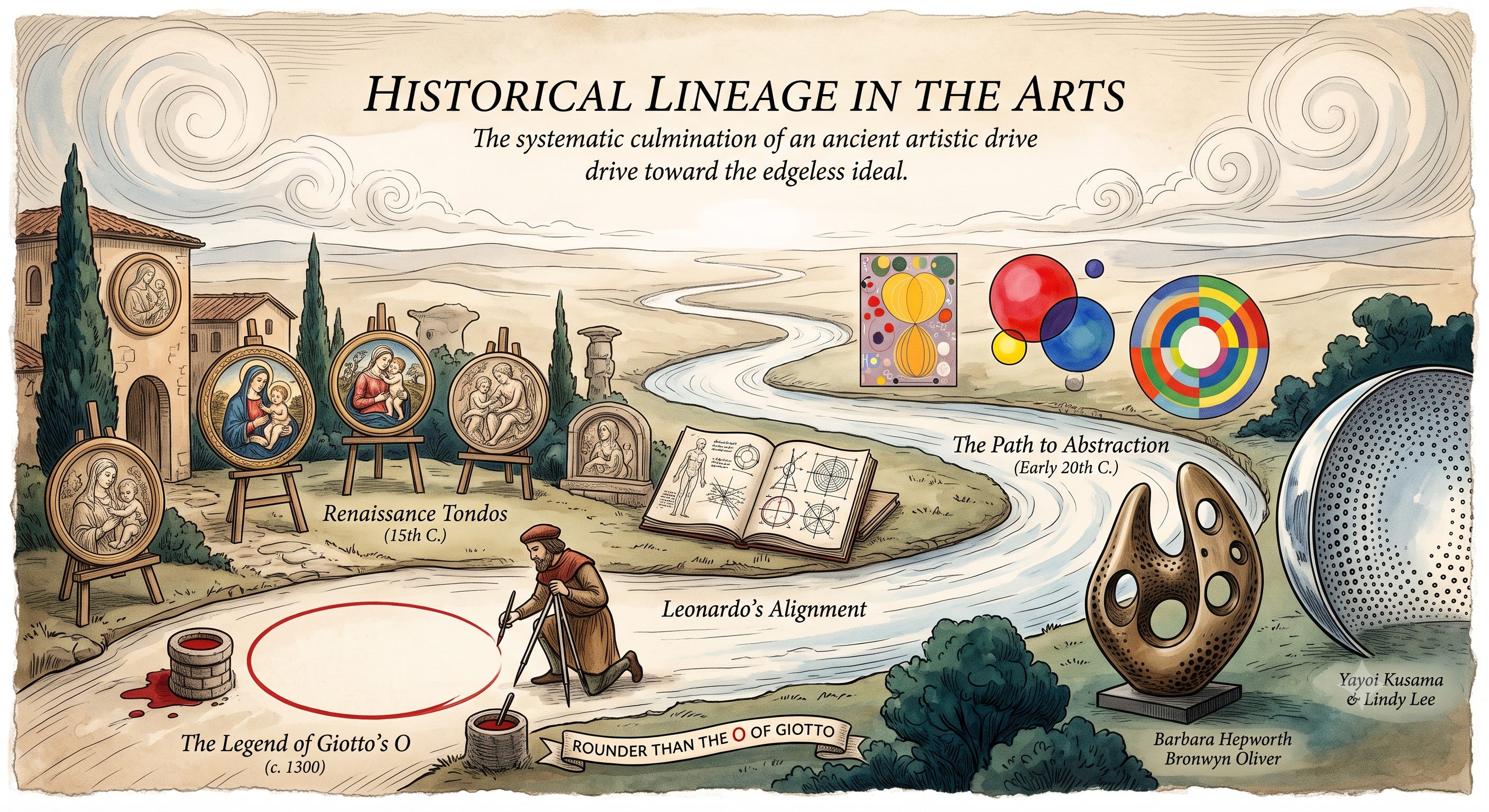
Renaissance Tondos: In the fifteenth century, circular paintings and relief sculptures, known as tondos, gained immense popularity in Florence and Tuscany. Masterpieces like Michelangelo’s Doni Tondo and Raphael’s circular religious icons elevated the round canvas as a sacred window into the transcendent.
The Legend of Giotto’s O: The historic ideal of artistic skill has long been measured by the circle. According to the Renaissance chronicler Giorgio Vasari, when Pope Benedict XI sent a courtier to Florence to evaluate Italian artists for a commission at Saint Peter’s Basilica, the messenger asked Giotto di Bondone for a drawing to prove his skill. Giotto immediately took a sheet of paper, dipped his pen in red ink, and keeping his elbow firmly pinned to his side like a compass, drew a freehand circle so flawless it was a marvel to behold. This singular stroke, historical proof of absolute physical coordination and technical mastery, won him the commission and gave rise to the historic Tuscan proverb, “rounder than the O of Giotto.”
Leonardo’s Alignment: While Leonardo da Vinci’s geometric pursuits, such as his Vitruvian Man, were mathematically driven by the Roman architect Vitruvius and classical geometry rather than Giotto’s specific story, his notebooks show he revered Giotto’s historic return to the raw perfection of nature. For Leonardo, the circular curve represented the ultimate isotropic boundary of light and spatial dynamics, establishing a clear conceptual line of heritage from Giotto’s red stroke to the complex geometries of the High Renaissance.
The Path to Abstraction: At the turn of the twentieth century, pioneers began exploring the round. Hilma af Klint bypassed figurative traditions to paint abstract circular systems in her Primordial Chaos series between 1906 and 1907. Wassily Kandinsky explored the cosmic resonance of overlapping spheres in his seminal works, “Several Circles” (1926) and “Circles in a Circle” (1923). František Kupka introduced purely abstract motion to Paris with his circular composition, “Amorpha: Fugue in Two Colors” (1912). Robert Delaunay explored chromatic rhythm using segmented rings in “Le Premier Disque” (1912), while Larry Poons utilized repeating dots in the 1960s to create vibrant optical fields. In sculpture, the elegant, fluid bronze and stone forms of Barbara Hepworth, the perforated globes of Australian sculptor Bronwyn Oliver, and the immersive, perforated, reflective circular systems of Lindy Lee and Yayoi Kusama have all pointed toward this edgeless world.
For additional Roundism influences, you can visit this page here.
Geometry and Mathematical Foundations
To establish a clear, modern reference for the movement, Roundism incorporates the precise language of classical mathematics and geometry:
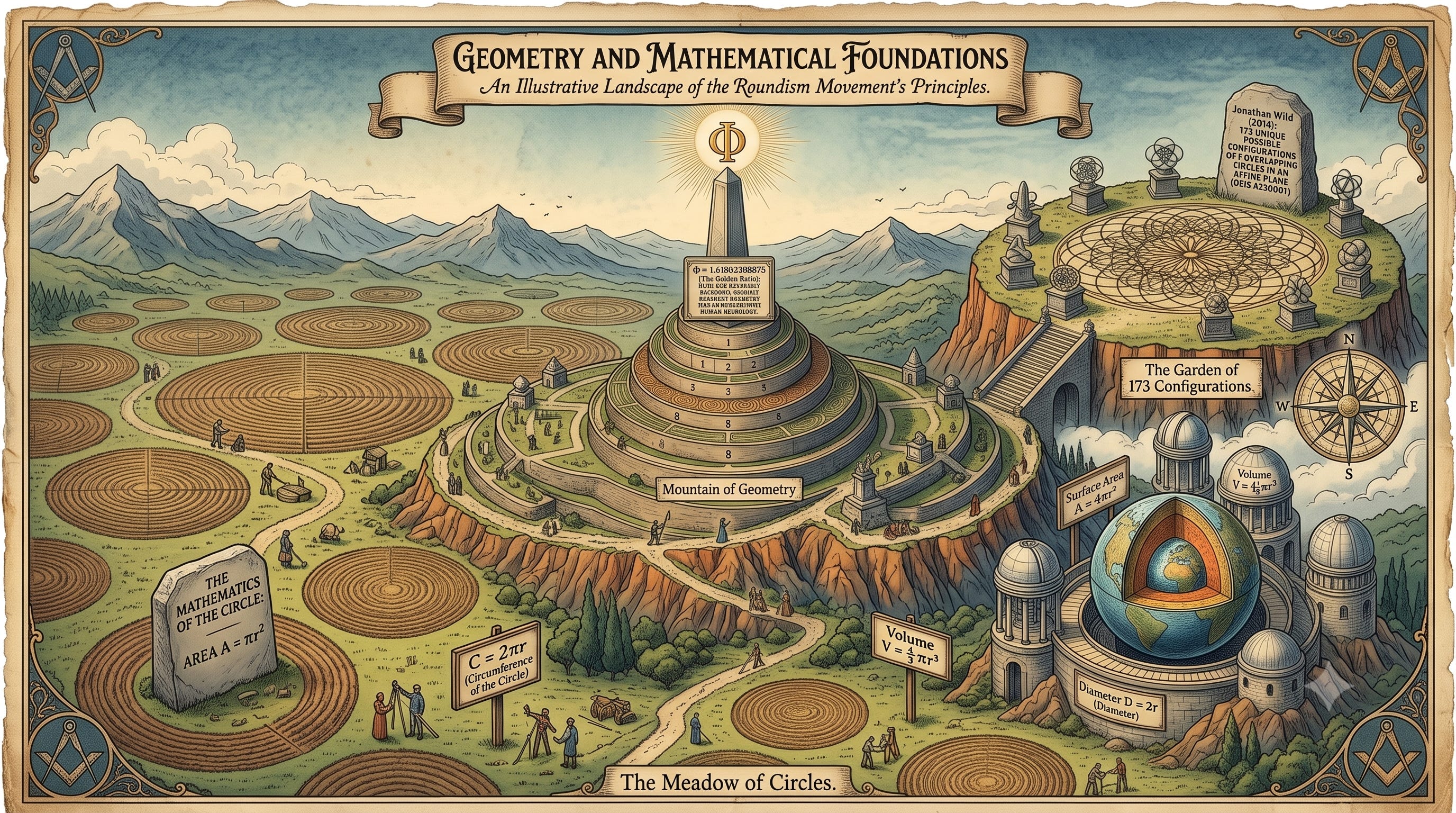
The Golden Ratio:
Represented by the Greek letter phi, where:
When applied to concentric circle configurations and proportions, the Golden Ratio yields a naturally balanced, visually coherent geometry that resonates with human neurology.
The Mathematics of the Circle:
For any circle of radius r, the circumference C is calculated by:
And the area A is calculated by:
The Mathematics of the Sphere:
For a three-dimensional sphere, the diameter D is:
The surface area A is:
And the volume V is:
To further understand complex spatial arrangements, the movement references established mathematical research, such as the calculations computed by Jonathan Wild in 2014, documenting the 173 unique possible configurations of four overlapping circles in an affine plane (documented in the Online Encyclopedia of Integer Sequences or OEIS as A250001).
For additional Roundism influences, you can visit this page here.
Studio Practice and Mediums
In my Mount Waverley studio, the physical realization of Roundism requires a dedicated focus on spatial engineering and geometric coordination. I have developed a multi-tiered approach to rendering edgeless forms across physical and digital surfaces, combining manual dexterity with custom physical templates:
Freehand Practice and Coordination:
Building the physical dexterity to draw and paint circles by hand is a foundational discipline of the movement. I embrace the organic, shaky human line as a valid expression of intent. Practicing hand-eye coordination daily serves to align the body with the mind, seeking to capture the spirit of Giotto’s effortless stroke.
Compasses and Scribing:
For larger geometric networks, I utilize modified compass systems. Scribing wood, raw paper, or canvas requires specialized marking tools that do not gouge the support. Custom-modified compasses allow for the precise layout of nested configurations and golden ratio networks prior to painting.
Stencils and Masking:
Through extensive studio testing, I have discovered that traditional flat stencils can bleed when applying wet mediums on flat surfaces. To resolve this, I design custom circular frames and physical masking structures. By cutting plastic polymer cylinders into clean rings of varying diameters, I create raised circular barriers. These let me paint nested configurations flat on the studio table without disrupting adjacent wet layers, keeping the edgeless boundaries exceptionally sharp.
Digital Mediums and Software:
The geometry of Roundism is beautifully supported by modern digital ecosystems. I utilize vector illustration tools and precise drawing software across multiple operating systems to draft complex, non-overlapping circle arrangements:
On Windows and Macintosh platforms, I utilize pen-enabled displays and dedicated drawing suites like Sketchbook to map out balanced golden ratio compositions.
For mobile drafting on Apple iPad and Android tablets, I recommend mandala-building utilities such as Spirality, alongside standard digital sketching tool sets. These platforms allow me to test complex geometric configurations before translating them to canvas or limestone.
It's still a developing art movement so there's lots of trial and error that I'm undertaking.
An Invitation to Join the Movement
Roundism is not a closed, personal style, but a structured art movement designed to grow across the fine-art landscape. It welcomes painters, sculptors, and installation artists who seek to explore the profound unity of the edgeless form.
By aligning our work with the fundamental geometry of the cosmos, we can create art that transcends cultural divides, calms the mind, and connects us directly to the transcendent.
To learn more about the movement and get in touch with me for training sessions contact me via roundism.michalplis.com to book a paid in-person or remote session.
My artwork
Original paintings and sculptures from my Roundism “New” collection are available for curatorial placement and private acquisition. To view the complete fine-art registry, inspect catalog provenance, or to arrange a private viewings in Melbourne, please connect via his official website at michalplis.com.
Book
I've begun the process of writing a book about Roundism Art Movement. If you are an art publisher, feel free to get in touch with me to work together to publish the book.
There's a lot more detail that can be talked about in the book format so I look forward to releasing that when I finished it!
But for now, I wish you all the best and thank you for reading this blog and I hope it has given you something interesting to think about and perhaps look at some of my art and if you're an artist then you can perhaps have a look at whether this art movement suits your direction.
Warm regards
Michal Plis
References
Official Roundism Website: roundism.michalplis.com
Roundism Manifesto: roundism.michalplis.com/#manifesto
Roundism Principles: roundism.michalplis.com/#principleso
Roundism Definitions: roundism.michalplis.com/#definitions
Roundism Philosophies: roundism.michalplis.com/#philosophies
Roundsim Influences: roundism.michalplis.com/#influences
Intro to Roundism video: On Youtube
“Individual locomotor bias drives counterclockwise motion in pedestrian crowds” published in Nature Communications in 2026
Swiss psychiatrist Carl Jung
“The Book of Circles”, researcher Manuel Lima
Online Encyclopedia of Integer Sequences or OEIS as A250001
Please advise in comments if there are any inaccuracies so I can then correct it.