

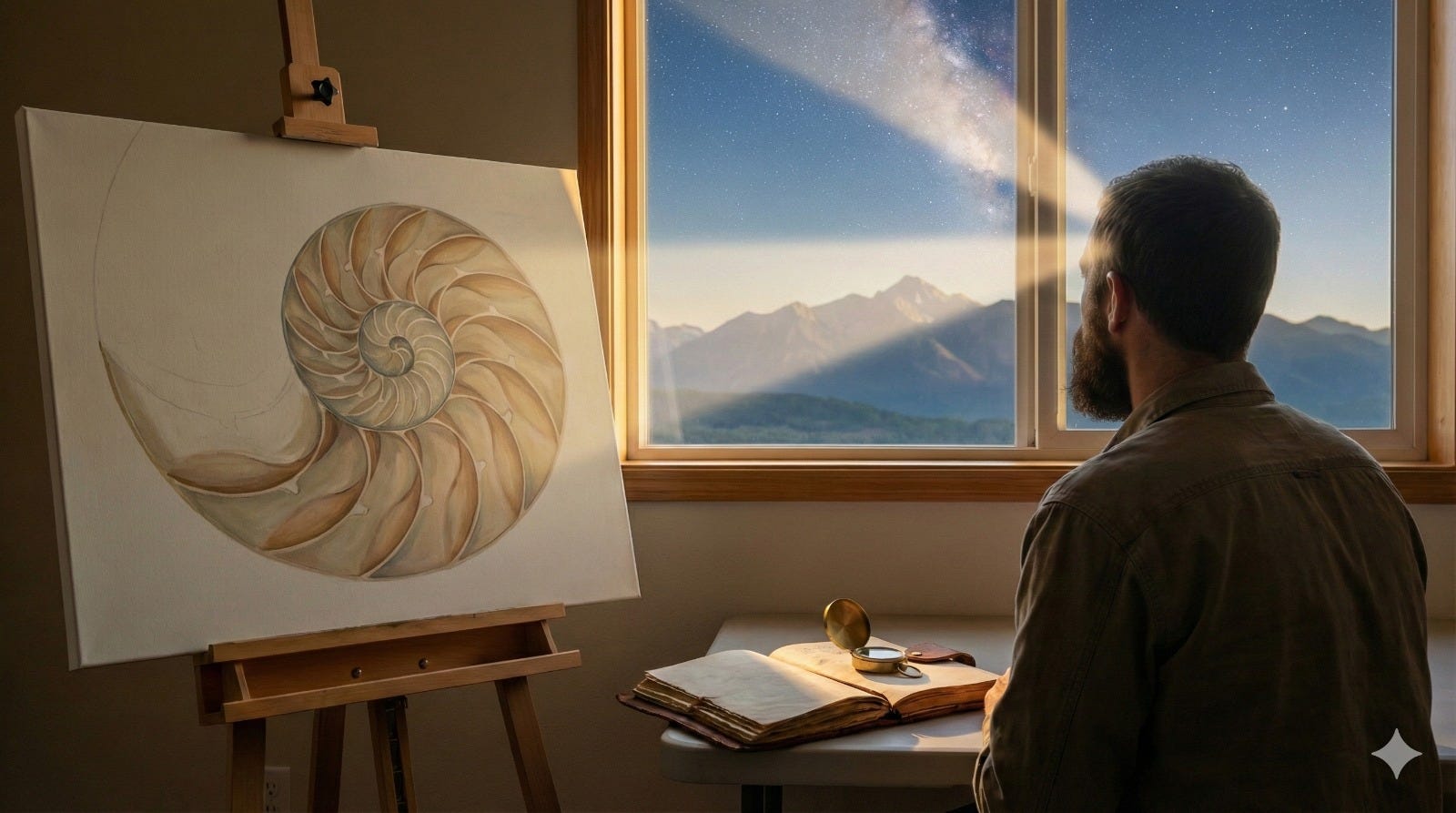
As an artist, I continually ask myself the questions: “What is Art?”, “What is arts essence?” and “Why do people need art in their lives?” In this article, I will dig deep into these fundamental art questions that, sadly, social algorithms and the commercial art world seem to be forgetting more and more.
Introduction
There is a growing trend in 2026 towards what many are calling a "Relational Renaissance" in the art world. For years, the focus has been on art as a digital asset or a speculative investment, but recent shifts show that people are becoming exhausted by the transactional nature of the industry.
Definition: The Relational Renaissance is a cultural movement where people are choosing deep, high-quality human presence over shallow digital interactions. It is the shift from just having connections (Relationship) to mastering the art of connecting (Relational)
Instead, we are seeing a powerful move toward localism and community-driven art. According to recent market reports and industry insiders, there is a renewed hunger for the "human touch", the physical studio visit, the story behind the canvas, and the raw, tactile experience of art that a screen simply cannot replicate.
This trend isn't just a whim; it’s a response to a deeper human need. In a world increasingly dominated by AI-generated noise and disconnected social algorithms, we find ourselves yearning for something authentic.
This brings us back to our core question: What is art, it's essence and why do we need it?
If the current trend tells us anything, it's that art is a vital bridge to the reality of the world around us. It is a reflection of the intricate design found in nature’s creation, and we need it because it grounds us, providing a peaceful, meditative space that helps us reconnect with our humanity and with one another.
So let's dig into what is art and why do we need it especially now in this hyper brain overload period. As I've mentioned in a previous post it would be good to live in the age of discernment.
What is arts essence?
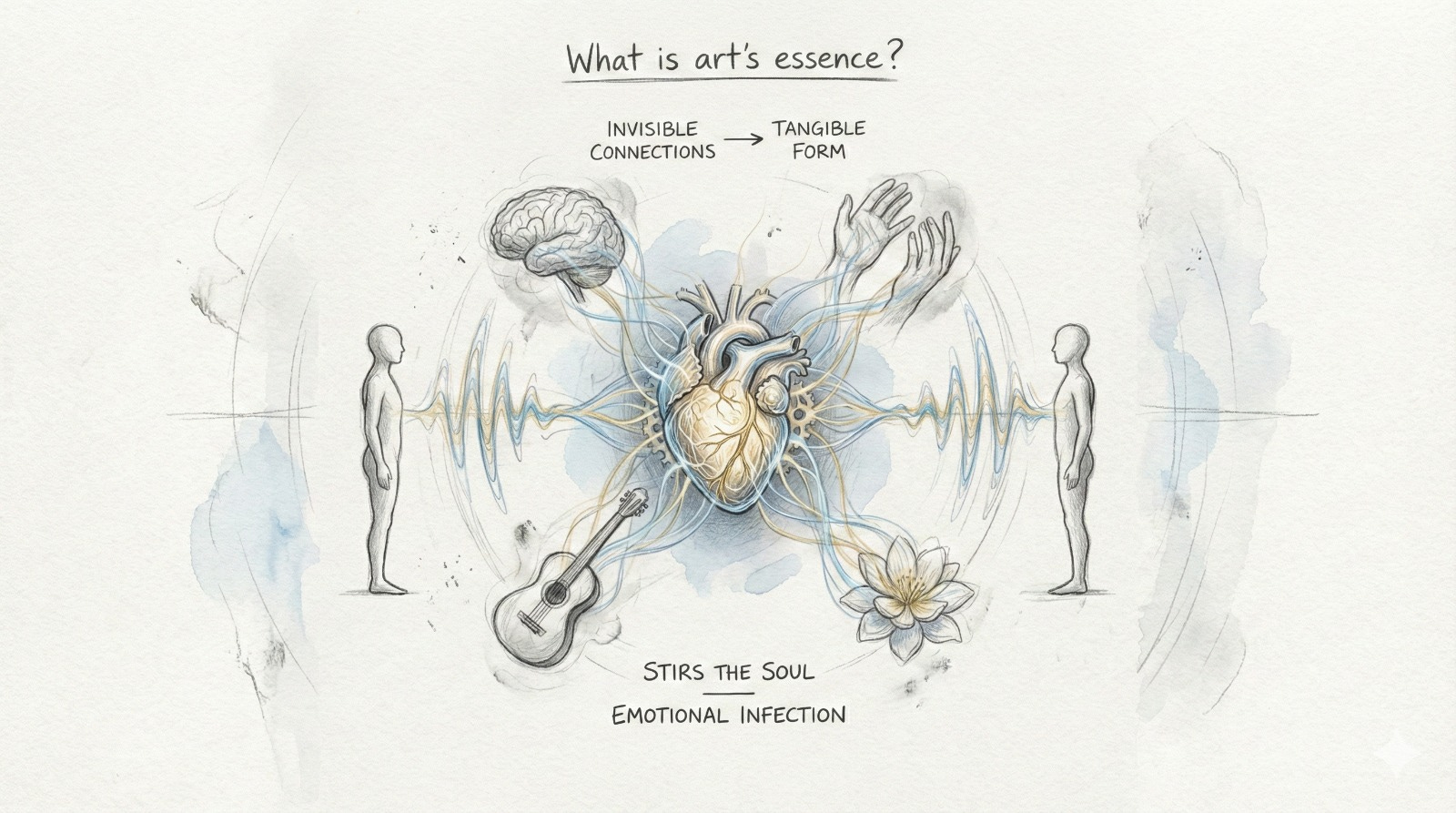
The answer to the question: What is the essence of art? Here is my answer in one sentence:
The essence of art is combining the invisible connections of human experience into something tangible that stirs the soul.
Of course there'll be many interpretations so it's hard to put it in one sentence, isn't it? But at least I gave it a go.
This idea that art is a conduit for the "unseen" is a concept shared by many notable thinkers throughout history. Leo Tolstoy, for instance, famously argued that the essence of art is "emotional infection", the ability of an artist to transmit a lived feeling so clearly that the viewer experiences it as their own.
Similarly, philosopher John Dewey postulated that art is not found in a static object on a wall, but in the active experience that occurs when a person engages with it. It is the moment where our senses and our environment reach a state of perfect, intentional harmony.
When we look at the complexity of the universe, from the mathematical precision of a spiral galaxy to the intricate biological patterns in nature, it becomes clear that humans possess an inherent "creative imperative" that mirrors a much larger, intelligent order.
The essence of art, therefore, is its ability to act as a silent, universal language. It allows us to take the abstract, often chaotic thoughts of the mind and anchor them into a physical form that honors the beauty and design we observe in the world around us. And it's not necessarily in a figurative way, As this can also be applied in purely abstract creations such as my own. In doing so, art doesn't just decorate a space; it validates our shared existence and provides a sense of grounding and purpose.
Okay, now that we've covered the subject of what is the essence of art now, let's ask the question. What is art.
What is art?
Then, what is art?
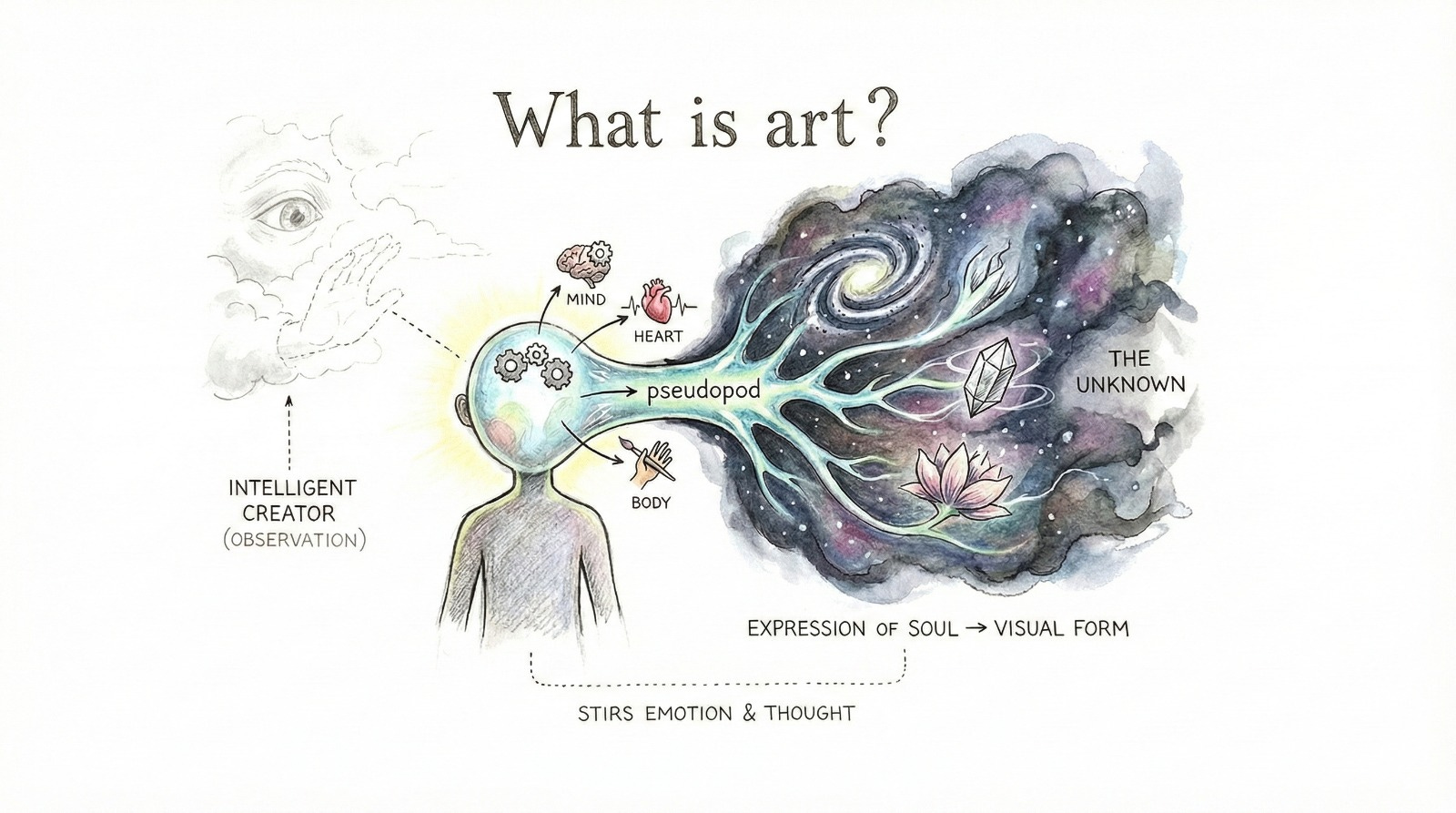
To me art is the expression of my soul (with my mind, heart and body) coming out to be shared in the visual form to the audience of humans and animals and extraterrestrial beings like the Creator of humans or other intelligent beings.
As an artist and an amateur scientist observing the universe, I cannot help but accept personally the existence of the Intelligent Creator. I accept that some readers of this article have different points of view about this, including the belief in evolution than creation. I respect your beliefs and opinions. And I hope that that you give me a chance to share what I believe through observation in nature. Many agree that the highly intelligent and intricate nature of the physical world begs to ask the question, is there intelligent design and artistry in it.
Another interpretation of what art is from a Canadian Psychologist Jordan Peterson who once said about art: “You can interpret it, and that’s helpful sometimes, just like movie criticism is helpful, but the dream is something that extends you beyond where you already are. That’s why it isn’t verbal thought, it’s something else. It’s like a pseudopod that’s going out into the unknown. That’s what art is”. And that's the big thought here that art art creates something new from the unknown from the subconscious from the things we don't see and brings it to the fore. And why does it stir emotion? And why does it stir thought?
Architecture of the Unknown
Expanding on Jordan Peterson’s idea of the "pseudopod into the unknown," we can look toward the work of Carl Jung, who influenced much of that school of thought. Jung suggested that art often taps into the "collective unconscious", a reservoir of symbols and patterns shared by all humanity. When an artist creates, they aren't just rearranging colours; they are acting as a conduit for things that exist just beyond the reach of language.
This is why a piece of art can "stir the soul" without a single word being spoken. It reaches into the subconscious to pull out truths that our rational minds haven't yet categorized. It is, in a sense, a discovery process, a way of mapping the territory of the human spirit that science is still trying to understand.
Artistry of the Physical World
As we look outward at the cosmos, the "artistry" we observe in nature often follows mathematical patterns that suggest a profound level of intentionality. For example, the Golden Ratio (\phi \approx 1.618) and Fibonacci sequences appear consistently in everything from the spiral of galaxies to the arrangement of seeds in a sunflower. From a purely scientific perspective, these are efficient biological and physical structures, but from an aesthetic one, they are masterpieces of art and design.
This inherent order suggests that the "Intelligent Creator" is the ultimate artist, using the laws of physics as a medium. When we create art, we are essentially trying to harmonize with these pre-existing patterns of beauty that were woven into the fabric of the universe long before we arrived.
Uniquely Human Resonance
Philosophers like Roger Scruton have argued that our ability to appreciate beauty is what distinguishes the human experience from the rest of the biological world. While animals may respond to colours or sounds for survival or mating, humans are unique in our ability to find "disinterested interest" in beauty, the capacity to be moved by something simply because it is.
This resonance suggests that our minds are "tuned" to the frequency of the universe's design. We don’t just see a sunset; we feel its depth. We don’t just hear a frequency; we experience a melody. This unique human capacity is a bridge; it connects our physical bodies to a higher plane of consciousness and points toward a purpose that transcends simple survival.
So thus humans have the ability to appreciate art far more than any other creature on this planet. And that in itself is an important thought that leads to the next question: Why do we need art in our lives?
Why do we need art in our lives?
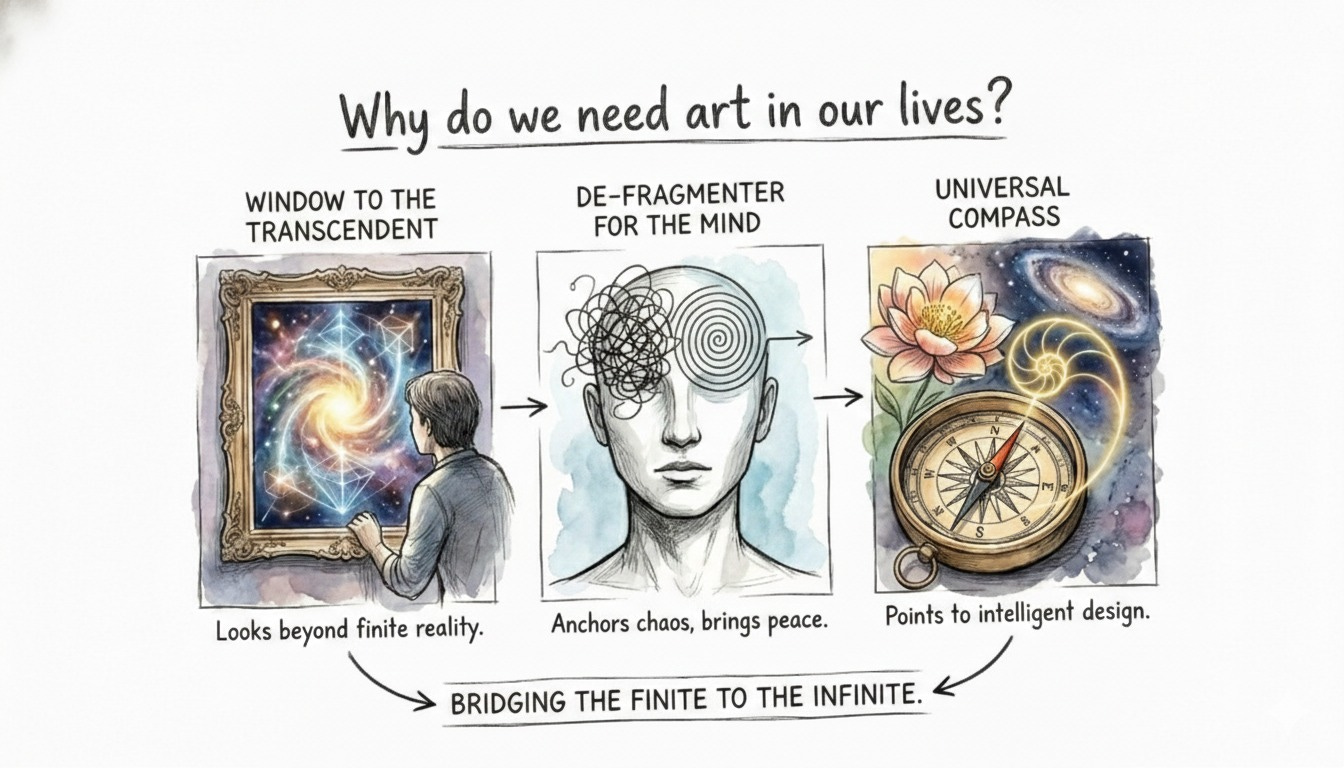
Here is an approximation of an answer from me: I think without art in our lives we would have boring lives and we would not be able to search into the hidden of the soul, so I think it's important that every person has artworks in their homes, whether they're paintings or sculptures or something else. These help connect us into the hidden or the transcendent or the unknown.
The Canadian Psychologist Jordan Peterson once shared a story in his Biblical Series X: Abraham Father of Nations that echoes this need.
He described standing in a "shrine-like" room at a museum in New York, surrounded by priceless Renaissance paintings and a crowd of people gazing in wonder:
“At the modern art museum of art and in New York. I'm afraid. I don't remember which one unfortunately, but I was in this amazing room, you know, it had all these priceless paintings from the late Renaissance hanging in it, you know, each painting worth, who knows a billion dollars. Maybe priceless. So the room was a shrine and it was full of people from all over the world who were looking at these paintings. You think. Well, what the (..) are these people doing coming to this room? Why are people looking at this painting? Why is this artwork in this room? Why does it cost a billion dollars? Why is that painting worth so much? We don’t really know. They did happen. They’re sacred objects in some sense and we gaze at them in ignorance and wonder. And the reason for that is that the unknown shines through the matus (from Hebrew מַתִּתְיָהוּ mattiṯyāhū meaning “gift of the Lord” or “gift of Jehovah”) and in partially articulated form. So, well, that's the role of art. That’s the role of artists.”
He further notes that creative action is what "revitalizes cities" and makes things "magnificent and beautiful." His advice is practical: buy a piece of art that speaks to you or your community, because it serves as a "lookout" or a "window into the transcendent." It expands us beyond our limited boundaries and ignorance.
So he said about the intrinsic value of art: “It's not that creative action is without value, right? Because the creative people are entrepreneurs and the creative people revitalise cities and the creative people make things magnificent and beautiful.”
Dr. Peterson also goes on to say about buying art and it's value in our lives: “So, anyway, so that's what artists are doing and so one of the things i would say is buy a (..) piece of art. You know, find one that really speaks to you and and buy a piece of art because you invite that into your life. And it's a lookout. If you do it, if it's a real piece of art because you'll also get a, you know, a little introduction to the artist and then that'll seep into your life and that'll change things like mad. But it's really it's unbelievably worth it because if it opens your eyes to the domain of the transcendent, that's the right way of thinking. About a real piece of art is a window into the transcendent, that's what it is and you need that in your life because you're finite and limited and bounded, right by your ignorance and your lack of knowing.”
Human Link vs. Automated World
As I mentioned in the foreword, we live in a society that has largely abandoned art for mass replication. Over the last two centuries, art has been slowly overtaken by technological advancements, from mass printing and photography to computing and now, in 2026, artificial intelligence agents and robots and so on.
This raises vital questions: Will this automation ever have true essence? Can it truly delve into the unknown, or does it merely regurgitate the "known"? I believe humans are uniquely linked to the possibilities of the unknown.
While AI may replace some forms of abstract reasoning and technical creativity, it can never replace the true essence of what it means to be human.
Art critic Jerry Saltz has recently (as of early 2026) maintained a critical yet nuanced stance on artificial intelligence, stating that while AI is a "tool" and "expansion of who gets to create," it cannot replace human artists because it lacks lived human experience, consciousness, and the ability to truly feel.
Jerry’s key points on why AI cannot replace artists include:
Lack of Lived Experience (”Meat Art”): Saltz argues that true art requires a visceral expression of human existence, famously noting that “without sex and death, there’s no art”. He contrasts “Meat Art” (human art) with AI, stating he wants the algorithm to “experience death” or “know the feeling of feeling like you have a fat neck, or bad hair”.
AI Art is “Average” and Derived: Saltz considers most AI-generated art to be “average,” calling it “90% crap”. He argues it is an “average of averages being fed an increasing number of averages”.
Art Needs Intention and Soul: He emphasizes that the value of art comes from human intention and meaning, which AI, treating pixels as statistical probabilities, cannot truly replicate.
“Shaman Pirates”: Saltz views artists as “shaman pirates living on the edge of the village” who will use AI as a tool, similar to paint or a digital file, rather than being replaced by it.
Key Takeaways from Recent Media Discussions (2025–2026) with Jerry Saltz:
Expansion, Not End: He often says AI is not the end of art, but an expansion of the tools available, urging artists to use it rather than fear it.
It’s a Tool: He compares AI to oil paint or a camera, a tool to be utilized, not a replacement for human soul.
“1 Day Old”: He has described AI as being “one day old” and in its infancy, noting that while it is currently “shite,” he acknowledges that “a Francis Bacon of AI art will emerge”.
So to summarise Jerry Saltz argues that: AI can replicate the aesthetic of a struggle or a victory, but it does not understand the internal mechanics of the objects it renders, essentially saying that artificial intelligence cannot replace the human story behind art.
The "pure logic" behind this lies in our biology. Academic studies in neuroaesthetics show that when we stand before an original work of art, our brain's precuneus, the area responsible for self-reflection and our sense of self… reacts with a depth that no digital reproduction can trigger. Art is a physical manifestation of the artist's entire makeup: their nervous system, their emotional centre, and their deep, mysterious links to the universe.
Humans have the ability to appreciate art far more than any other creature on this planet. This unique capacity is what allows us to bridge the gap between our finite lives and the infinite beauty of the design around us.
Future of Feeling: Why Authenticity is the Currency of 2026 and beyond
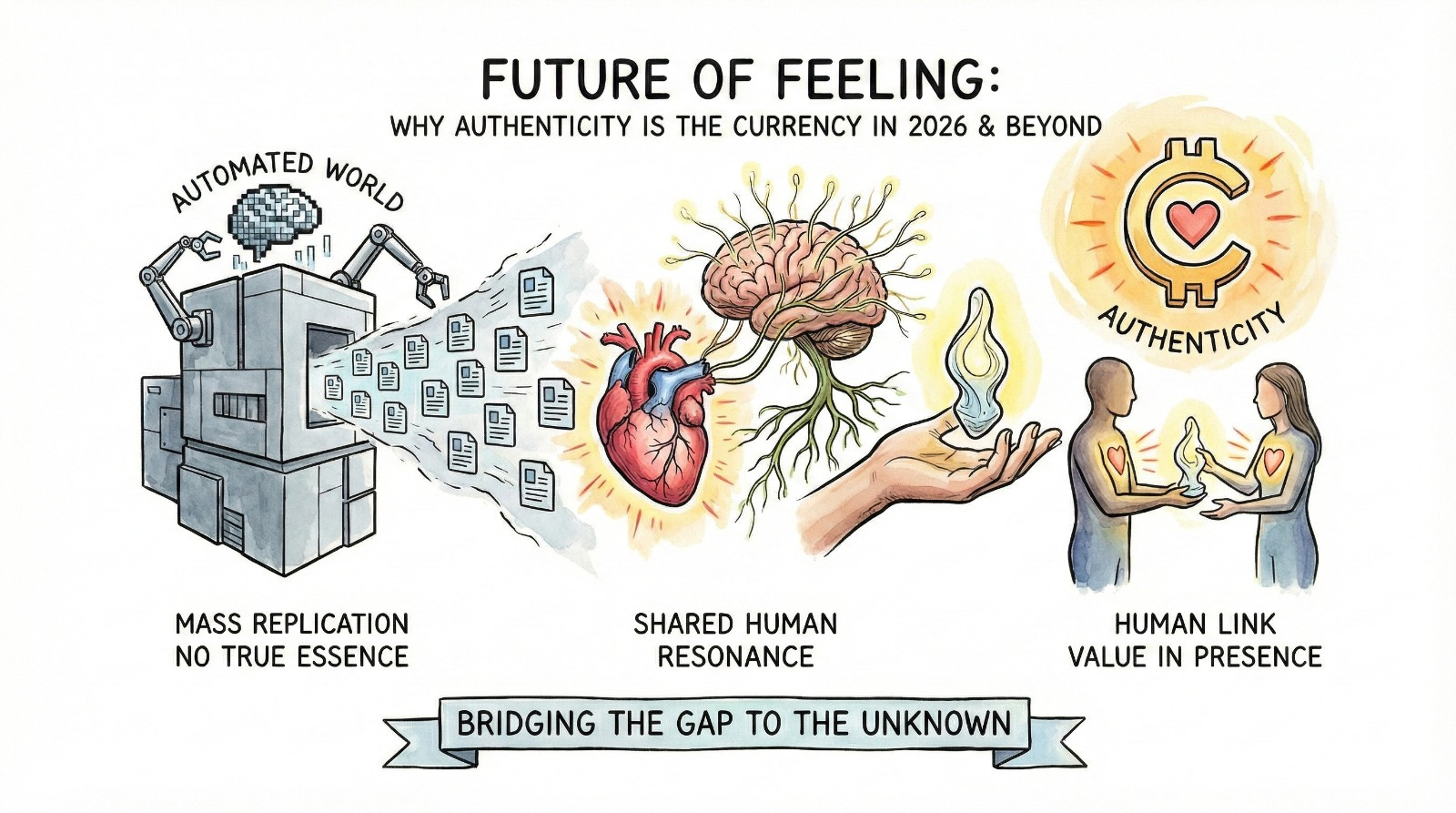
As mentioned in the foreword, we live in a society that has largely abandoned art for mass replication. Over the last two centuries, art has been slowly overtaken by technological advancements, from mass printing and photography to computing and now artificial intelligence. This raises a vital question: will this automation ever have true essence? Can it truly delve into the unknown, or does it merely regurgitate the "known"?
Humans are uniquely linked to the possibilities of the unknown. While AI may replace some forms of abstract reasoning and technical creativity, it can never replace the true essence of what it means to be human.
The logic behind this lies in our biology. A new study at the Mauritshuis Museum in The Hague showed that original art stimulates the brain far more than reproductions. Using eye-tracking equipment and an electroencephalography (EEG) brain scanner, researchers found that physical pieces of art induced a stimulus 10 times stronger than museum shop posters of the same works. The results showed that real-life artworks activated the precuneus, the part of the brain associated with self-reflection.
Art is a physical manifestation of the artist's entire makeup: their nervous system, their emotional center, and their deep, mysterious links to the universe. An automated process simply cannot activate that shared human resonance.
Inviting the Unknown into the Home
Understanding the biological and psychological depth of original art leads us to a practical conclusion: art is not merely interior design. Bringing an original work into your living space is about creating an environment of reflection and a focal point for the mind.
Here are some considerations to think about about art in your apace:
Artwork is a Window to the Unknown: As Dr. Peterson noted, a real piece of art is a "lookout." It serves as a daily window into the transcendent, helping us navigate our own finite limitations and the boundaries of our ignorance.
Artwork is a De-fragmenter for the Mind: A busy mind or a chaotic day requires a visual anchor. A genuine artwork orders chaos and provides a peaceful, seamless space for your mind to rest and reflect.
Art is the Universal Compass: Just as a magnetic compass points to a force we cannot see, our deep human attraction to authentic beauty points toward an intelligent source of that beauty. Having these works in our homes serves as a daily reminder of the intricate, intelligent design of the world around us.
As we have learnt, humans have the ability to appreciate art far more than any other creature on this planet. This unique capacity is what allows us to bridge the gap between our everyday lives and the profound mysteries of existence. But how do we deal with the confusion today of what fine art is?
Why less and less people know what fine art is?
Take, for example, the recent collectible craze. Artists are increasingly using this model to create mass-market collector’s items out of artworks. It is an interesting experiment, but in my opinion, it devalues art as a whole in favor of profit. It might be financially valuable at the moment, but remember, as with all collectibles, it loses value over time if it is merely a fad.
Here are a few prominent examples of how the line between commercial product and high art is being blurred:
CJ Hendry: Perhaps the most prominent Australian artist (or designer) currently being questioned on the use of collectible craze, Hendry has built a massive global following through social media and hyper-realistic drawings and then has gone into AI generated collectibles art among other things. There is a audio discussion looking at both sides of what she does on ABC Art Show.
Her Collectible: In late 2025, she launched “juju,” a character featuring a flower over one eye, released through high-end sculptures and blind-box bag charms.
The Criticism: Critics have labeled her work as “ridiculous” and compared the frenzy to the “fidget spinner” obsession of 2017. Some argue she is a “disruptor” who blurs the line between commercial product and high art, leading to questions about who gets to decide “what is art”.
Her Response: Hendry describes the project as a commentary on the “ridiculous” Labubu craze itself, using it as a “public experiment in authorship” that involves AI and audience feedback. I question whether it goes outside the realm of art especially when she uses AI to create these designs.
Damien Hirst : A long-time provocateur, Hirst has often been criticized for the “industrial” scale of his production and his embrace of speculative markets.
His Collectible: His project “The Currency” (2021) involved 10,000 unique spot paintings, each tied to an NFT. Collectors had to choose between the physical painting and the digital token; the version not chosen was destroyed. And he got others to primarily make it. Where do we draw the line?
The Criticism: Hirst is frequently accused of prioritizing profit and extreme wealth over artistic substance. His reliance on assistants and his focus on “repetition and seriality” have been cited as evidence of the “commercialization of his art”.
Kasing Lung (The Creator of Labubu): While Lung started as a traditional illustrator, the massive commercial success of his characters through Pop Mart has changed how his work is perceived.
His Collectible: Labubu, a “toothed elf” from the The Monsters series, has become a global phenomenon, with revenue for the line increasing by over 700% in 2025 alone. It also has religious and spiritistic overtones that some aren’t aware of.
The Criticism: Because the toys are sold primarily through “blind boxes” (where the buyer doesn’t know which figure they are getting), the work is often viewed more as a speculative asset or a gambling-adjacent product than as a fine art sculpture. Rare editions can fetch over $3,000 on the secondary market, fueling a “shadow economy” of scalpers and counterfeiters.
Banksy: Though his work is inherently anti-commercial, the massive secondary market for his prints and the “stunts” associated with them have led some to question if the “mystery” is now just a marketing tool.
His Collectible: Official works authenticated by his “Pest Control” office serve as highly guarded collectibles. His Girl with Balloon sold for £18.6 million in 2025 after a famous live-shredding stunt.
The Criticism: While he remains anonymous to avoid legal trouble, some argue his “secrecy” is now the primary factor driving his market success, turning his “street art” into a billionaire’s investment vehicle.
Why this is commercialization, not fine art?
People used to collect marbles, yoyos, and all kinds of similar items, and they have very little value now. Fine art is beyond that. It is not a fad or a temporary gimmick designed to just make money.
Is there a bigger problem with art world or perhaps with Modern Art or Contemporary Art? The period of demise may be here. Listen to what another artist Dries Ketels explains about in his video “Artist Explains: Why I Hate Modern Art”.
I think true fine art stands the test of time. It reaches into our soul, into the unknown that we are not familiar with, to teach us something and help us become more aware of ourselves, of others, and the universe around us. It is a far better investment than a commercialized collectible made by AI or designed for the mass market.
Some say that we have reached an Orwellian world, much like the 1984 novel, where culture is being degraded into a mechanistic, controlled system. In this case, it is driven by artificial intelligence engines and hype algorithms, watering art down into an intellectual slop not worth a cent. It completely misses the deep level of how human souls reach into the unknown to connect with the Creator (if you believe in that, like myself).
Learn more about fine art and what it means
I would like to conclude by encouraging all art collectors, interior designers, dealers, curators, and critics to remember these important points. Do not blindly follow the trends of the art world today that head towards commercialization, mass production, and far away from what fine art truly means.
If we look at the insights from top industry voices in 2026, the mandate for authenticity over commercialization is clear. Let us break down what this means for the stewards of our visual culture:
For Collectors and Dealers: The 2026 art market is demonstrating a clear shift as buyers become more discerning, choosing to focus on value rather than hype. We are seeing a slowdown in sales of highly speculative works, with collectors instead prioritizing artistic coherence, authenticity, and long-term potential. Fine art carries the distinct presence of the “artist’s hand,” elevating the piece beyond mere decoration into an object of meaningful artistic value. Investing in authentic works contributes directly to the continuation of an artist’s legacy. In contrast, mass-produced pieces function as endless commercial products that lack deep emotional connection. By prioritizing emotion, authenticity, and artistic identity over fast trends, collectors create a more stable environment to invest in art with genuine long-term value.
For Interior Designers: For interior designers, art plays a central role that goes far beyond mere decoration; it functions as a core aspect of a living space’s mood, identity, and harmony. Selecting authentic fine art is about finding pieces that emotionally resonate. As top designers note, choosing a single piece you truly love will bring more soul to a room than a collection of mass-produced items chosen simply to fill empty wall space. Mass-produced works often use generic paper or low-grade canvas, whereas authentic art utilizes high-quality materials that beautifully showcase the visual depth and retain their condition over time. Authentic art acts as the focal point, the kinetic vessel that anchors the energy of a room and invites the unknown into the home.
For Curators and Critics: Critics and curators play a crucial role in influencing the market, providing institutional recognition, and contextualizing artworks within history. Because contemporary art often lacks objective quality criteria, curators provide essential “status signals” to help stabilize value and communicate meaning. Looking at the trends for 2026, leading curators are prioritizing slower, more deliberate forms of art and exhibition-making. There is a renewed emphasis on hand-made, material, and craft-based practices. Even as technology like AI advances, top curators are approaching it with ethical restraint, seeking to position it alongside physical materials and personal experience rather than allowing it to replace them. Curators have the unique authority to prioritize artistic merit and philosophical rigor over the increasing financialization of the market.
Please continue to learn more about what art means, and I hope this article, and future ones from me on this subject, helps you become a smart art collector and dealer.
If you found value in this, please share this article with other readers who might appreciate it. I also encourage you to leave your thoughts in the comments below, and please subscribe to the Studio Blog so you never miss future insights into the world of fine art.
Until next time,
Michal Plis
"The essence of art is combining the invisible connections of human experience into something tangible that stirs the soul."
What a perceptive definition of art!
Keep sharing more, please.
God bless you,
Roy
It's always a tough one to try and answer these questions, but they're important. I'd love to hear your opinions and your thoughts on this subject