

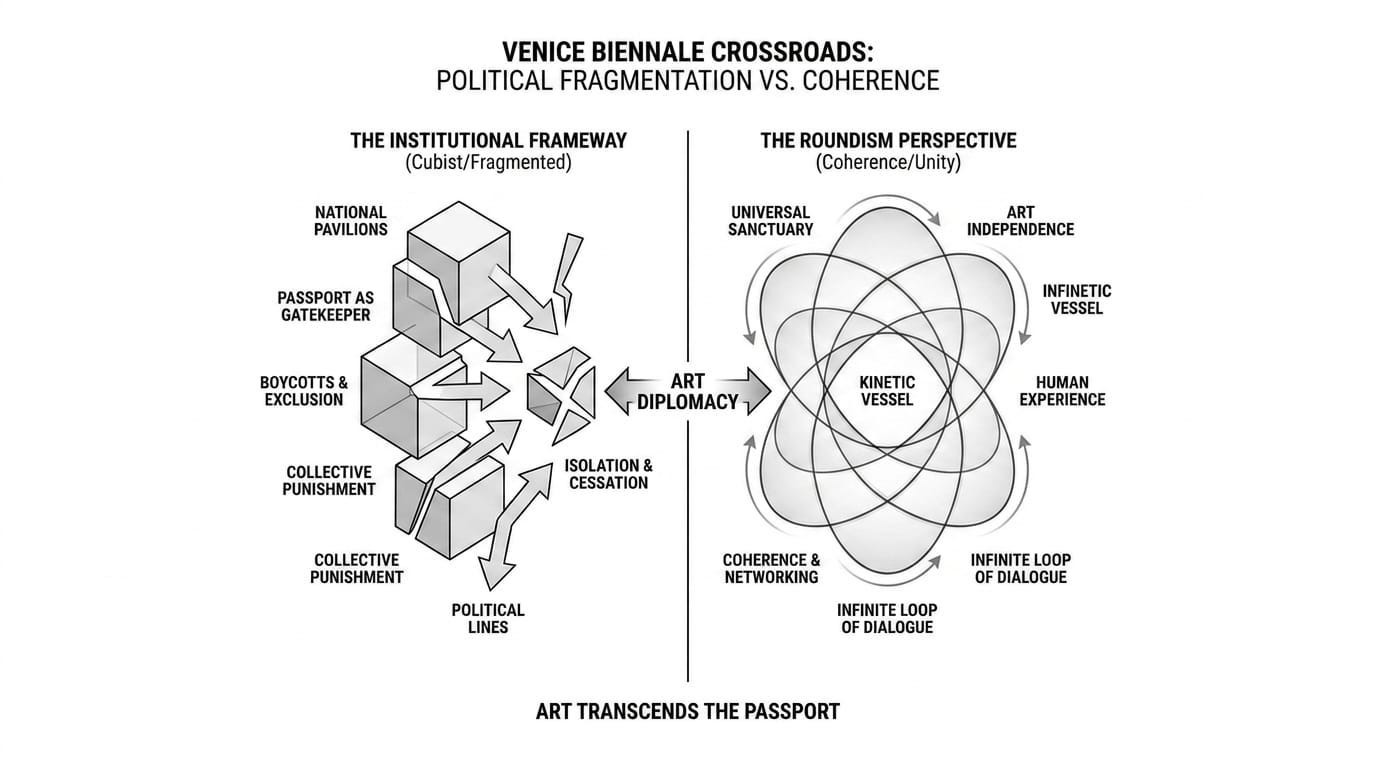
The art world is currently vibrating with a tension that threatens to crack its very foundation. As the 2026 Venice Biennale approaches, we find ourselves at a crossroads, trapped between the institutional weight of national pavilions and the individual integrity of the artist.
With jury resignations, funding threats, and heated debates over which flags are “worthy” of flying in Venice, the dialogue has shifted from the canvas to the boardroom, and from the aesthetic to the geopolitical.
Recently, I’ve been engaged in a rigorous debate with colleagues regarding these boycotts. It has forced me to look at this chaos through the lens of my movement, Roundism, to see if we can find a path back to coherence.
The Institutional Argument: Art as a State Asset
The argument for exclusion is often rooted in the “Institutional Frame.” Critics argue that because the Venice Biennale is structured around National Pavilions, the art within them is inherently a diplomatic asset. They suggest that:
The Pavilion is the State: Therefore, keeping a pavilion open for a nation involved in conflict is seen as a silent endorsement of that state’s actions.
Economic Accountability: Boycotts and funding withdrawals are used as the only “levers” available to the art community to show moral disapproval.
While I understand the emotional weight of these arguments, I believe they rely on a worldview of fragmentation, the very thing Roundism art movement seeks to heal.
The Roundism Perspective: Ordering the Chaos of Art Diplomacy
In my studio, I utilize my neurodivergence as a creative engine to see geometry and order where others see only noise. When I look at the Venice Biennale 2026 crisis, I apply the three pillars of Roundism Art Movement:
1. Coherence vs. Political Fragmentation
Politics is the art of drawing lines. It is the definition of fragmentation, similar to the sharp, broken edges of Cubism. Roundism, however, is a visual methodology for achieving unity. When we exclude an artist based on their passport, we are adding another sharp edge to a world already cutting itself to pieces. We must strive for coherence, a networking of forms where the human experience remains unbroken regardless of borders.
2. Kinetic Vessel and the Infinite Loop in art diplomacy
I view art as a Kinetic Vessel, an active trap for energy and attention. It is designed to capture the chaos of the world, circulate it, and release it as a purified, stronger clarity.
When an institution shuts down a pavilion, they aren’t just punishing a state, they are breaking the vessel. They are stopping the circulation of the very dialogue that could lead to a wider understanding. This is art diplomacy.
3. Pursuit of the Edgeless Ideal in International Art
Humans, and the governments they form, are inherently organic and imperfect. However, art represents our intent toward perfection. My work is also a search for the “edgeless ideal,” a geometric truth that transcends chaotic reality.
Our global art stages should be the physical manifestation of that edgeless ideal, a space where no one is “cut off” and the focus remains on the work, not the identity of the person who created it.
This too helps with art diplomacy. But unfortunately that's not the case and may never happen in current human systems we live in.
Danger of Collective Punishment
We are witnessing what I can only describe as a modern witch hunt in the art world not unlike the #metoo movement. Metoo movement had important points for women’s rights but did it in such a way as to forget about due process and just do collective judgement and collective execution. Not unlike the public hangings in the middle ages. This in turn damaged the reputations of innocent people. If we begin judging passports instead of art then we are engaging in collective punishment of countries or artists that belong to those countries.
“If the Biennale started selecting works [on the basis of] passports, it would cease to be what it has always been: the place where the world comes together.” - 2026 Venice Biennale president Pietrangelo Buttafuoco.
In the same address, Pietrangelo further defended the Biennale institution’s independence from geopolitical censorship with these additional remarks:
“We select works, not passports.”
“This is not a court of law. It is a garden of peace.”
“The only veto is pre-emptive exclusion.”
“Art must not exclude anyone.”
“We do not intend to trade, for the sake of a quiet political life, 130 years of history that have always told the world this way.”
President of the Italian Republic Sergio Mattarella, he said something important about the cultural boundaries that art should embody, he said: “Art is not a tribunal”.
History is a messy, organic timeline. If we were to look back over the 131-year history of the Biennale, almost every participating nation has had chapters of history they are not proud of. If moral purity was the metric for entry, the Giardini would be an empty forest and the Arsenale would be a ghost hall.
Art should be a sanctuary, an independent space where we fight our wars with points of view rather than weapons. We can call this art diplomacy. When we allow politically driven decisions to dictate the guest list, we lose the only Infinite Loop of communication we have left.
The arguments
The Italian government and European Commission have increased the pressure by threatening to pull funding, effectively treating the Biennale as a diplomatic instrument rather than a purely artistic one. Is it a good idea to affect the integrity of this event for a very long time political score pointing? Below are the arguments out there for and against.
Arguments for Exclusion from Biennale
Accountability: Proponents argue that state-sponsored pavilions are "soft power" tools used to whitewash war crimes and should not be treated as neutral.
ICC Standards: The jury cited international law, arguing that rewarding states whose leaders face war crimes charges violates the Biennale's commitment to human rights.
Arguments for Inclusion from Biennale
Universalism: Organisers like President Buttafuoco argue that judging "passports instead of art" destroys the Biennale's essence as a global meeting place.
Selectivity: Critics (including the Israeli artist Ruth Patir) have called these specific bans "discriminatory," noting that many participating nations have past or present human rights issues.
A Call for Independent Art
I am not suggesting we ignore the world’s pain. Quite the opposite. I am suggesting that art is the only tool we have that is strong enough to hold that pain as the artist wants to without breaking established platform for political pressure or point scoring.
We must protect the independence of the artistic space. We must allow the “round” to encompass all of us, even when it is difficult. Because if we lose the ability to see each other through our art, we have truly lost our way. When that happens we start to go towards Owrellian 1984 world without art at all.
Questions for comment:
I am curious to hear from my fellow artists, critics and curators: Should the institutional frame of a "National Pavilion" always be tied to the actions of a state, or can we allow the art to stand on its own merit?
Should art be a tool for state accountability, or a universal sanctuary for connection?
Keep creating,
Michal Plis
References
References & Further Reading below.
The Observer: Pietrangelo Buttafuoco: The conservative intellectual at the heart of Venice’s Biennale storm: https://observer.co.uk/news/profile/article/pietrangelo-buttafuoco-the-conservative-intellectual-at-the-heart-of-venices-biennale-storm
Italian Facts: Venice Biennale 2026 between art and tensions: Buttafuoco relaunches “freedom and audacity”: https://www.italianfacts.com/en/art-6665-venice-biennale-2026-between-art-and-tensions
On the Institutional Argument (Art as a State Asset & Boycotts):
The Concept of "Soft Power" in Cultural Diplomacy: Reference: Joseph S. Nye Jr.'s foundational concept on how nations use culture to build influence. URL: https://foreignpolicy.com/1990/09/01/soft-power-foreign-policy-magazine-joseph-nye/
Woodrow Wilson Center: Soft Power Foreign Policy Jospeh S. Nye Jr. Full text PDF: https://share.google/3KsXcC4VCYONomsxo
The 2022 Russian Pavilion Resignations: Reference: A modern precedent of artists withdrawing to hold a state accountable, effectively shutting down their own national pavilion. URL: https://www.artforum.com/news/russian-pavilion-artists-and-curator-resign-from-venice-biennale-252441/
The "Art Not Genocide Alliance" (ANGA) 2024 Petitions: Reference: The open letter signed by thousands of cultural workers demanding the exclusion of national pavilions based on state actions. URL: https://hyperallergic.com/4000-art-workers-call-for-israel-exclusion-from-the-venice-biennale/
Institutional Critique: Reference: An overview of the art movement that questions the political and economic structures of art institutions. URL: https://www.tate.org.uk/art/art-terms/i/institutional-critique
On the Roundism Perspective (Art as a Universal Sanctuary):
The Danger of Passport-Based Censorship: Reference: The PEN International Charter, which strictly advocates that literature and art must remain a common currency among people despite political upheavals. URL: https://www.pen-international.org/who-we-are/the-pen-charter Select About us > Who we are then select Read PEN Charter
The 1968 Venice Biennale Protests: Reference: Historical context on when political unrest forced the Biennale to reconsider its institutional structure and refocus on individual artistic voices. URL: https://www.labiennale.org/en/history-biennale-arte
The Biennale as a Space of Dialogue (Curatorial Precedents): Reference: Adriano Pedrosa’s curatorial statement for the 2024 Biennale, emphasizing the inclusion of marginalized or displaced voices across borders. URL: https://www.labiennale.org/en/art/2024/statement-adriano-pedrosa
Cultural Diplomacy and "Track II Diplomacy": Reference: The United States Institute of Peace definition of non-governmental, informal interactions (like art) used to maintain human connection when official state relations break down. “The Role of Cultural Diplomacy in Strengthening Soft Power in a Globalized World” URL: https://uscpublicdiplomacy.org/blog/role-cultural-diplomacy-strengthening-soft-power-globalized-world
Track Diplomacy: From a Track Perspective - MIT Press Direct - PDF: https://share.google/eJeEOqeWkngHRRlWb