


When you go to a gallery or look for an artist online to buy art, do you struggle to work out how to categorize it?
Art is categorized, divided, organized, and sorted in many ways. In this guide, I have summarized all the major divisions to help art buyers and collectors understand exactly what they are looking at and what they are buying.
Contents
Introduction
Why Am I Sharing This Knowledge Freely?
What Are the Different Ways Art is Organized, and Why Does It Matter?
The History of Art Categorization
Time Division: Navigating Historical Eras
Figurative Art (Real or Representational World)
Abstract Art (Non-Representational Realm)
Traditional Art (Art of the Past)
Contemporary Art (Art of the Present)
An Academic Note on the “Modern Art” Movement
Chronology in Art: Periods, Movements and Schools
Art Period
Art Movements
Art School
1. Art Form
2. Art Medium
3. Art Technique
4. Art Genre
5. Art Style
6. Art Purpose or Function
7. Cultural or Regional Context in Art
Category Tip for Collectors
Why Am I Sharing This Knowledge Freely?
Some people spend thousands of dollars at formal art academies just to grasp these concepts. However, I believe that if the visual arts are to grow in popularity and become truly accessible for everyone to start their own collections, this knowledge must be freely shared. The profound impact that an artwork can have on a living space, and the vital support it provides to the artist, is simply too immense to keep hidden behind a paywall.
In a way, the art world can be intensely gatekept, not unlike historical eras when institutional authorities strictly controlled the translation and distribution of foundational texts. While modern art academics certainly won’t burn me at the stake for breaking down these academic walls, they might not be thrilled that I am handing out this guide for free! That said, formal institutions still play a highly important role for those who wish to dive even deeper into art theory.
A Note on Accuracy: My goal is to establish objective facts in art categorization rather than just sharing personal opinions. If you notice anything that needs adjustment or correction, please reach out to me through my social media channels or via the contact form on my website michalplis.com. We are all continuously learning, and I welcome your feedback.
So, How Is Art Categorized?
Art, in its infinite forms, reflects the profound diversity of human experience, emotion, and creativity. Categorizing these creations is essential for navigating and appreciating such a rich spectrum, whether it is for academic study, interior design, museum curation, or the personal joy of building a collection.
This organizational process relies on multi-layered methods that take into account core attributes like style, medium, historical period, cultural context, and the foundational message or purpose of the artwork. Ultimately, these classifications provide a roadmap through the art world, making it seamless to recognize historical patterns, decode an artist’s true intent, and understand how different masterpieces relate to one another across time.
What Are the Different Ways Art Is Organized, and Why Does It Matter?
Art can be categorized in a variety of ways, by historical period, artistic movement, medium, form, style, and purpose. However, these classifications frequently overlap, which can naturally lead to confusion and misconceptions about how artworks are organized. Understanding these distinct layers is crucial for anyone looking to appreciate visual culture on a deeper level, whether you are a collector evaluating an investment piece, an interior designer space-planning a project, or a curator organizing an exhibition.
To truly make sense of these overlapping systems, we must explore the specific roles they play in our broader understanding of art history and individual artistic practices. This guide aims to untangle those complexities, laying out the clean structural frameworks that bring order to centuries of human creativity.
But where did this institutional sorting actually begin? Let’s trace the origins of how humanity first started categorizing art.
The History of Art Categorization
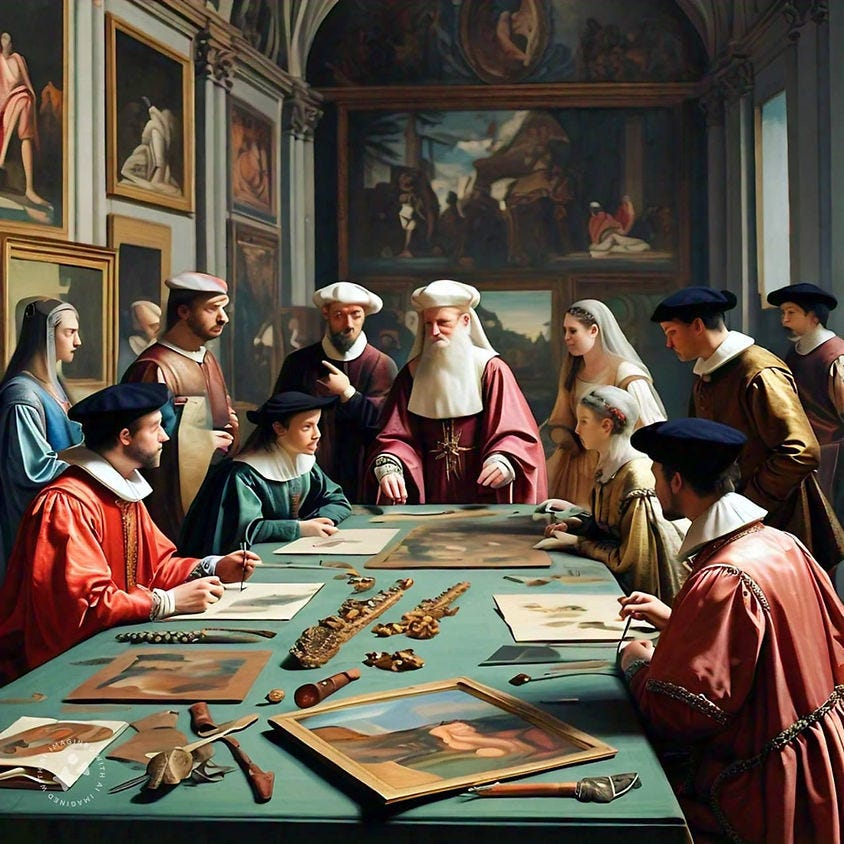
The practice of categorizing art has roots that stretch back to ancient civilizations. Early efforts to organize and classify art were often tied to religious and cultural practices. In Ancient Egypt, for example, art was categorized based on its function, with a strong emphasis on the spiritual and the afterlife. The Greeks and Romans, on the other hand, began to categorize art based on style and subject matter, laying the groundwork for the distinction between genres like portraiture, landscape, and still life.
During the Renaissance, art categorization became more formalized as scholars and artists sought to revive and build upon classical traditions. The development of art academies in Europe further solidified these categories, as they emphasized the importance of technique and subject matter in their teaching. Artists were often classified by the medium they worked in, painting, sculpture, or architecture, and by the subjects they depicted, such as history, religion, or mythology.
As the centuries progressed, art categorization evolved in response to new movements and ideas. The 19th century saw the rise of art criticism and the establishment of more nuanced categories, driven by the desire to differentiate between styles like Romanticism, Realism, and Impressionism. By the 20th century, the explosion of modern and contemporary art brought even more complexity, with categories being defined not just by style and subject, but by the artist’s intent, philosophy, and even their cultural or political statements.
Today, the categorization of art continues to evolve, reflecting the diversity and global nature of the art world. While traditional categories like genre, medium, and style remain important, there is also increasing recognition of the need to consider context, identity, and the cultural significance of artworks. This historical journey of art categorization shows how our understanding of art has expanded, helping us appreciate the rich and varied tapestry of human creativity.
Time Division: Navigating Historical Eras
To truly understand the evolution of art, we must be able to place it accurately on a historical timeline. Art is inherently bound to the era in which it was created, and its date often provides the first clue to its cultural and political context.
While humanity has tracked time in various ways throughout history, the modern global art market and academic institutions primarily utilize a two-part chronological system. It is essential to understand these designations when looking at historical art:
BCE (Before the Common Era) / BC (Before Christ): Years marked with BCE or BC count backward from the estimated birth of Jesus Christ. For example, an ancient Egyptian artifact created in 1300 BCE was made over a millennium before this milestone. In academic writing and museum curation today, BCE is the preferred, secular standard.
CE (Common Era) / AD (Anno Domini): Years marked with CE or AD count forward from the year 1. CE stands for the Common Era, which is the academic equivalent to the traditional AD (Anno Domini, meaning “In the year of our Lord”). We currently live in this era. For instance, a Renaissance painting from 1500 CE belongs to this forward-counting timeline.
By mastering this historical dating system, collectors and art lovers can easily track the chronological progression of human creativity.
Now, in the sections that follow, we will dismantle the complex walls of the art world and explore the exact structural attributes used to categorize art today, giving you the ultimate framework to appreciate, analyze, and confidently select pieces for your own collection.
Fundamental Division of Art
When attempting to classify any piece of visual art, I believe it is essential to first establish the baseline division: the real versus the imaginary. Categorizing art based on whether it represents the observable world around us or a hidden, non-existent realm helps ground the entire direction of the artwork being viewed.
What can complicate this division is when an artwork seamlessly weaves real and imaginary elements together. In those instances, the work becomes a hybrid, existing simultaneously as both abstract and figurative. However, my baseline methodology for evaluating all visual art begins by separating it into these two foundational realms:
Figurative Art (Real or Representational World)
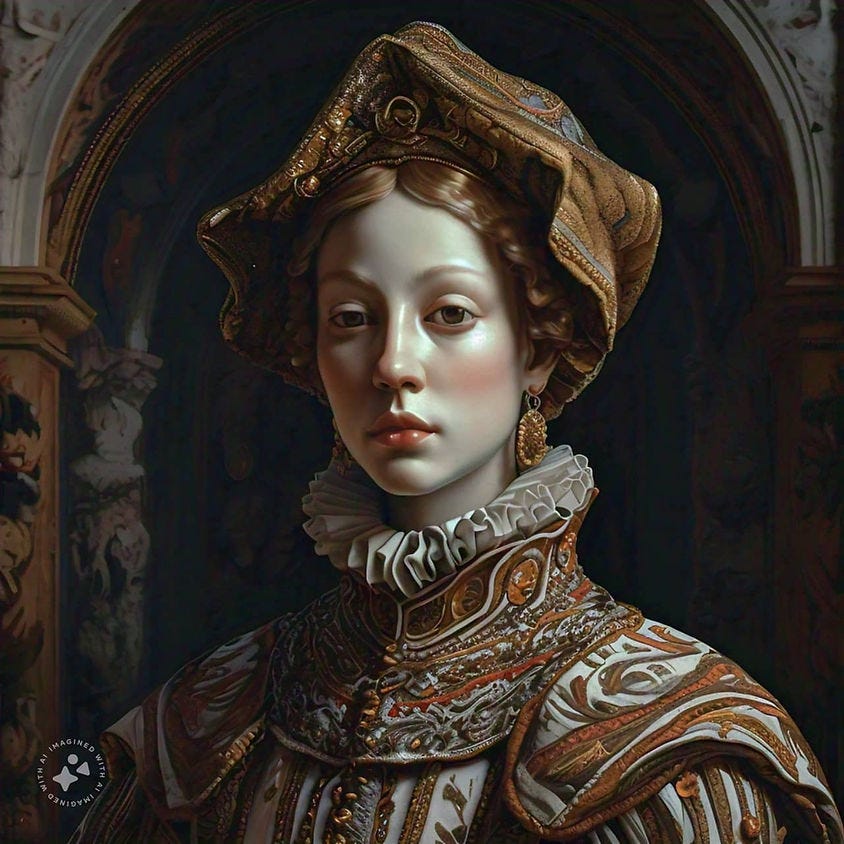
Figurative art uses a visual language of shape, form, color, and line to create compositions that clearly reference the physical universe around us. A common academic misconception among casual viewers is that “figurative” only relates to paintings of the human form. While it absolutely encompasses the human body, figurative art includes all real-world subjects.
Key Characteristics of Figurative Art:
Representation of Reality: Figurative art aims to reference the physical world and its objects. This includes depicting people, animals, landscapes, and everyday items in a way that remains recognizable to the viewer, even if the forms are highly stylized.
Interpretation of the Visual Environment: Artists manipulate foundational elements, such as tone, perspective, and colour, to interpret real-world subjects, conveying specific details, moods, or characteristics.
Not Limited to Figure Painting: Figurative art is an umbrella term. It is not restricted to anatomy; it encompasses still lifes, maritime scenes, traditional landscapes, and architectural environments.
Figurative Art Across Historical Movements and Periods:
To understand how this representational language has evolved through time, let’s look at how different historical movements and periods have approached the real world:
Traditional & Classical Realism: Historically, this includes academic traditions where artists aimed to depict subjects with immense precision, technical mastery, and strict attention to anatomical or environmental detail, as seen in Renaissance masterpieces or 19th-century Realism.
Surrealism (The Realistic Impossible): This 20th-century movement masterfully blends the figurative with the imaginary. Surrealist artists use highly realistic, figurative rendering of recognizable figures and objects, but place them in dreamlike, illogical, or subconscious settings, creating a jarring, captivating fusion of reality and imagination.
Expressionism & Modern Figuration: These modern historical periods frequently use figurative subjects to express deep emotional, spiritual, or quality psychological states rather than focusing on photographic realism. These movements intentionally distort, fragment, or manipulate recognizable forms to convey raw subjective human experiences.
The Purpose and Impact of Figurative Art:
Communication of Ideas: Figurative art serves to communicate ideas, emotions, and narratives through recognizable subjects. It can convey stories, document realities, or reflect cultural and personal perspectives.
Connection to the Viewer: By depicting familiar subjects, figurative art often establishes an immediate connection with the viewer. This connection can enhance understanding and appreciation of the artwork, as viewers can relate to the depicted subjects.
In essence, figurative art is about creating visual representations of the real world or real objects. It allows artists to explore and depict the physical universe in a way that resonates with viewers through recognizable forms and subjects.
Abstract Art (Non-Representational Realm)
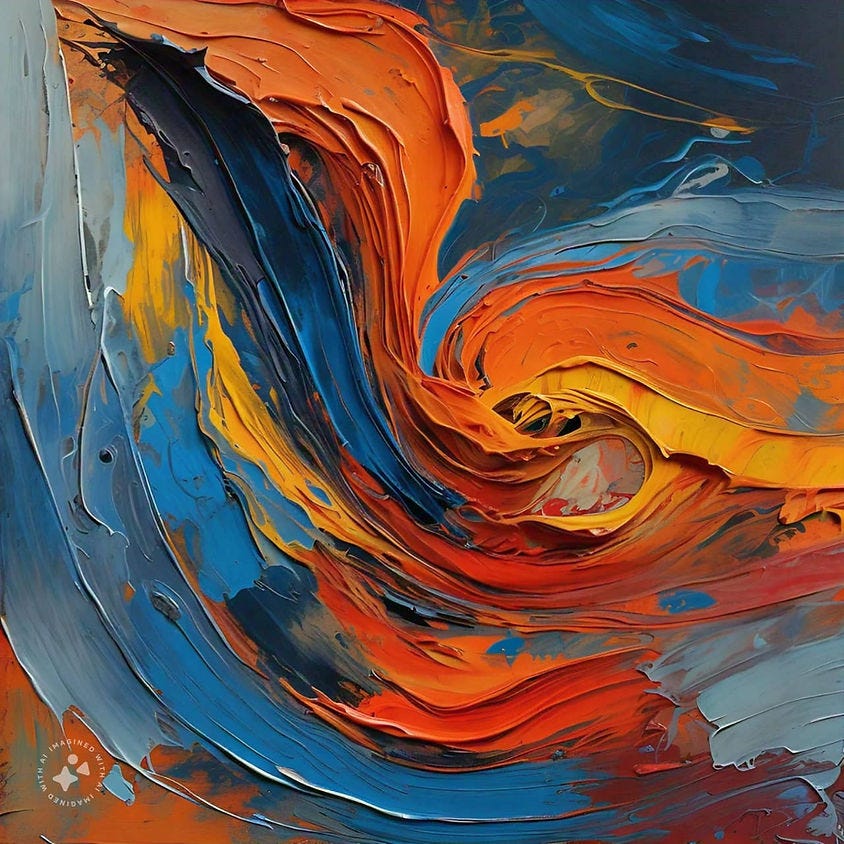
Abstract art uses a visual language of shape, form, color, and line to create compositions that intentionally do not represent or depict the physical universe around us. Rather than mirroring literal reality, it departs from the visible world to explore the intangible, the emotional, and the unseen.
Key Characteristics of Abstract Art:
Non-Representational: Abstract art does not depict specific objects, people, or scenes. Instead, it uses visual elements in a non-literal way, allowing for a vastly broader range of personal interpretation and emotional response.
Emphasis on Pure Visual Elements: Rather than referring to an external, physical subject, artists work directly with form, color harmony, texture, and line to evoke pure aesthetic experiences or internal concepts. The visual elements are the subject matter.
Subconscious Imagination: Abstract art relies heavily on the viewer’s own imagination and interpretation. Because the subject matter is not explicitly defined by a real-world anchor, the viewer is actively encouraged to engage with the artwork on a deeply personal, subjective level.
Abstract Art Across Historical Movements and Periods:
To trace how this non-representational language has evolved through time, let’s examine a few prominent historical movements and periods that broke away from literal reality:
The Early 20th-Century Avant-Garde: True abstraction emerged prominently in the early 1900s as a dramatic rebellion against academic realism. It evolved in stages: movements like Cubism began by fracturing and semi-abstracting real-world figures. This quickly paved the way for pioneers like Wassily Kandinsky and Piet Mondrian to dive into pure abstraction (often called Non-Objective Art), using geometric or lyrical forms to express raw spirituality and emotion entirely free from earthly constraints. This historical arc culminated mid-century with Abstract Expressionism, where artists like Jackson Pollock used monumental scale and dynamic gesture to record pure psychological energy.
The Surrealist Period (Biomorphic Abstraction): While Surrealism is widely celebrated for its dreamlike, illusionistic figuration (such as Salvador Dalí’s work), the movement also birthed a major wave of abstract exploration. Artists like Joan Miró and André Masson utilized “automatic drawing” to create biomorphic abstraction, using organic, fluid shapes that did not map onto real objects but instead sought to capture the raw subconscious mind.
The Contemporary Abstract Movement: In the contemporary era, abstraction continues to rapidly expand and evolve. Modern abstract artists cross traditional boundaries by incorporating digital software, complex mixed media, and unconventional, raw materials to continuously push the absolute limits of non-representational expression.
The Purpose and Impact of Abstract Art:
Exploration of Intangible Concepts: Abstract art allows creators to visually communicate complex ideas, philosophical theories, and deep-seated emotions that simply cannot be captured through literal, representational painting.
Individualistic Engagement: The open-ended, non-literal nature of abstraction acts as a conversational mirror for the viewer. Because there is no single “correct” meaning, each collector, curator, or designer derives a completely unique visual and sensory feeling from the piece, making the acquisition of abstract art a highly individual experience.
Pure Sensory Experience: Abstract art frequently prioritizes immediate aesthetic harmony and emotional impact over a structured narrative. It offers a sensory immersion that resonates on a completely different psychological wavelength compared to figurative art.
In summary, abstract art is a profound category of expression that prioritizes raw visual and emotional experiences over realistic depiction. By focusing entirely on the foundational, atomic elements of design, it liberates the creative process, opening up an infinite realm of imagination for both the artist who commands the canvas and the collector who brings it into their home.
With these fundamental divisions established, let us now examine the specific historical frameworks the art world uses to categorize these expressions across time.
Historical Division of Art
Another primary method the art world uses to classify works is by looking at established methods from the past versus how art is conceived and executed today. Broadly speaking, this system divides visual culture into two major eras: art of the recent present and art of the distant past, with the watershed boundary usually falling around the mid-20th century.
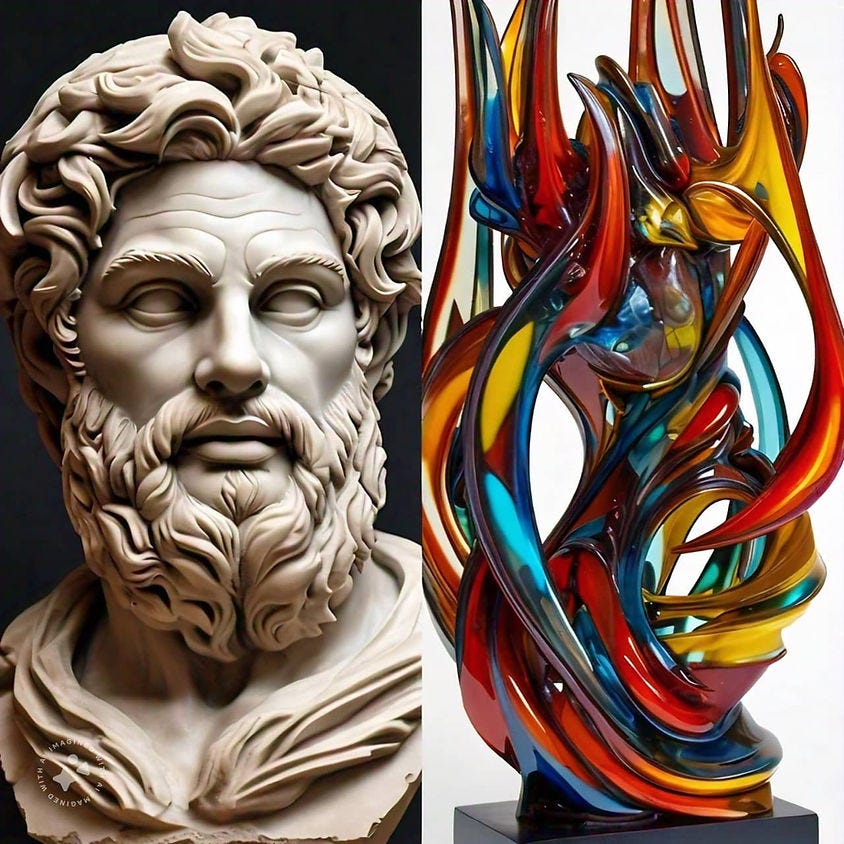
Both approaches to making art are profoundly valid. Yet, a clear divide still exists within modern creative communities, even here in Melbourne, separating strict traditionalist circles from contemporary-focused artists and collectors. These two schools of thought occasionally clash, with traditionalists sometimes dismissing current trends as “not real art,” and contemporaries labeling classical methods as “outdated.”
To that ongoing friction, I say we should invoke the ancient Roman word: Pax (peace). Life is simply too short to squabble over creative philosophies; let us maintain everlasting peace between these schools, recognizing that both serve an invaluable role in human culture.
To map out this temporal landscape accurately, let’s examine the two primary historical divisions recognized by art historians and curators:
Traditional Art (Art of the Past)
Traditional art refers to time-honoured, established methods of visual expression refined over centuries. It encompasses well-defined styles, rigorous techniques, and aesthetic rules passed down through generations of masters.
Historically, this umbrella term covers major European movements prior to the mid-20th century, such as the Renaissance, the Baroque era, and Neoclassicism.
Today, certain art communities adhere strictly, almost religiously, to these traditional methods. In my experience, these circles can sometimes be hesitant to recognise abstract artists or those working in avant-garde styles that emerged after the mid-20th century. However, there is room for everyone in the visual landscape, provided that both traditional and contemporary creators maintain that everlasting Pax (the Roman word for peace).
Important Distinction: It is crucial to note that “Traditional Art” is a broad overarching category, whereas the “Classical Art” Period is a specific historical era with its own distinct philosophy.
A Academic Note on the “Classical Art” Period
Strictly speaking, Classical Art refers to the visual culture produced by ancient civilisations, most notably ancient Greece and Rome, spanning roughly from 500 BCE to 500 CE. Its influence, however, extends far beyond antiquity, serving as the blueprint for the Renaissance and later Neoclassical revivals.
Classical art is defined by an absolute devotion to harmony, geometric proportion, balance, and idealised beauty. Rather than capturing random everyday moments, classical masters focused on subjects from mythology, religion, and epic history, rendering human anatomy and architecture with a pursuit of flawless realism.
The underlying philosophy of the Classical period is deeply rooted in order, rationality, and symmetry. It reflects the humanist values of the societies that birthed it, celebrating human potential, intellectual achievement, and the orderly pursuit of visual perfection.
Contemporary Art (Art of the Present)
Contemporary art refers strictly to visual art produced by artists living and working in our current era. Because time is a moving target, defining the exact start date can be complex, but art historians generally draw the line at the mid-to-late 20th century. Essentially, it is the art of our collective right-now.
Consciously breaking away from the rigid structures of classical and traditional art, contemporary art is incredibly diverse, fluid, and eclectic, frequently defying clean categorisation. It embraces a limitless range of mediums, welcoming digital art, immersive installations, video art, and performance pieces alongside traditional painting and sculpture.
Rather than focusing solely on visual aesthetics, contemporary art is often deeply conceptual. The underlying idea, message, or societal critique is frequently just as important, if not more important, than the physical object itself. Heavily influenced by Postmodernism, contemporary creators use their work to explore pressing global dialogues, including identity, globalisation, rapidly evolving technology, and environmental concerns.
Predictably, this conceptual shift ruffles some feathers, and certain contemporary artists hold a mutual disdain for strict traditionalists. But as I mentioned before, the art ecosystem thrives on variety; both camps must find a way to maintain that everlasting Pax (peace).
Important Distinction: A very common mistake among new buyers is using the words “Modern” and “Contemporary” interchangeably. In professional art circles, Contemporary Art is what is happening today, whereas Modern Art is a specific, closed historical movement from the past.
An Academic Note on the “Modern Art” Movement
The Modern Art movement represents a finite historical epoch spanning roughly from the 1860s to the 1970s. It was characterised by a radical, exciting break from academic traditions and the strict realism of the past.
As the world experienced rapid industrialisation, urbanization, and technological progress, artists responded with a profound sense of optimism, innovation, and experimentation. They began manipulating raw form, color, and texture for pure expression, giving rise to some of the most famous avant-garde movements in human history, including:
Impressionism
Cubism
Surrealism
Abstract Expressionism
While modern art paved the way for the total creative freedom we see today, it remains a distinct historical period. Understanding this boundary allows collectors to look at a piece and immediately know whether they are looking back at the foundation of modernism, or engaging with a direct commentary on our current world.
With our fundamental timelines and divisions of reality established, let us now delve into the specific structural groupings that define the art market: Art Movements, Schools, and Periods.
Chronology in Art: Periods, Movements and Schools
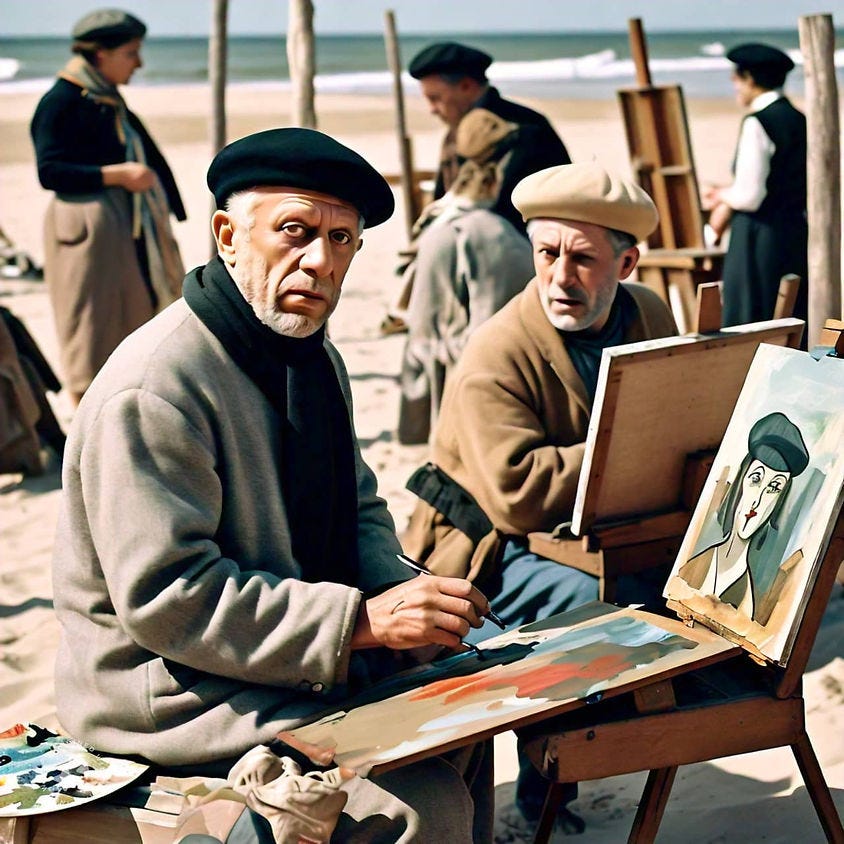
Periods, movements, and schools form a vital framework in art history. They group artworks that share specific visual principles, technical methodologies, and underlying philosophical goals. These groupings are typically driven by a collective of artists working within a particular window of time, though their influence can echo across centuries.
While these concepts are essential branches of broad art categorization, they are so influential that they deserve their own dedicated analysis. To navigate a gallery or auction catalog like a seasoned professional, a collector must understand the precise academic definitions of these three distinct chronological markers:
Art Periods (Broad Temporal Eras): A period is a large, sweeping block of time usually defined by overarching political, social, or cultural shifts. Artists working within a specific period do not necessarily know each other, nor do they follow a single shared style, but their work is inevitably shaped by the historical climate of their era. Examples include the Renaissance, the Baroque period, or the Edo period in Japan.
Art Movements (Intentional Philosophies): A movement is a conscious, deliberate collective of artists who intentionally band together to achieve a specific aesthetic goal or champion a shared philosophy, frequently driven by a published manifesto. Movements are typically shorter-lived than periods and are bound by rigid conceptual rules rather than just a calendar date. Examples include Impressionism, Cubism, and Surrealism. In the contemporary landscape, artists often revive the stylistic “rules” of a historical movement without being bound to the era it was birthed in.
Art Schools (Geographic or Institutional Linages): In art history, a “school” rarely refers to a literal classroom. Instead, it defines a group of artists who share a distinct style or philosophy because they are bound by a specific geographic location, a shared master, or a centralized institution. For instance, right here in Victoria, the famous Heidelberg School defined Australian Impressionism in the late 19th century, just as the Bauhaus School revolutionized design in Germany.
Understanding how periods, movements, and schools intersect gives you the ultimate roadmap to decode an artist’s lineage. It transforms an artwork from an isolated image into a fascinating link in a chain of human evolution.
Let’s dive deeper into how these specific temporal classifications operate across the art market.
Art Period
An art period refers to a specific span of time in art history during which certain styles, techniques, themes, and cultural influences were predominant. An art period is often characterised by a shared artistic approach and philosophy among artists, typically reflecting the broader social, political, and cultural changes of the time. From an academic standpoint, while an art movement is formed intentionally by the artists themselves, an art period is a large sweeping era usually designated retroactively by art historians looking back at a timeline. Understanding art periods helps in placing an artwork within its historical context, allowing for a deeper appreciation of the influences and innovations of that time.
Chronological Framework: Art periods are typically defined by approximate start and end dates that correspond to significant changes in artistic practices or major historical events. For example, the Renaissance (14th to 17th century) marked a revival of classical ideas and an emphasis on humanism, while the Modern period (late 19th to mid-20th century) is characterised by intense experimentation and a break from traditional forms.
Examples of Major Art Periods:
The Renaissance (14th to 17th Century): Focused on the classical revival of Greek and Roman ideals, humanism, and scientific realism.
The Baroque (17th to Early 18th Century): Known for its intense emotional grandeur, dynamic movement, and dramatic use of light and shadow.
Romanticism (Late 18th to Mid-19th Century): Emphasised raw human emotion, the sublime power of nature, and individualism.
Modernism (Late 19th to Mid-20th Century): Defined by rapid industrial innovation, abstraction, and a deliberate departure from traditional, realistic forms.
The Contemporary Period (Late 20th Century to Present): Encompasses a wide, fluid range of styles and approaches, deeply reflecting current social, political, and technological trends.
For collectors, developing a working knowledge of art periods is one of the most practical tools you can possess. Recognizing the historical period of an artwork doesn’t just help you appreciate its story; it provides essential clues regarding its rarity, its place in visual evolution, and its long-term market value.
When you understand the cultural forces that shaped a specific era, you can look at a piece with far greater clarity. Ultimately, anchoring your collection in a solid understanding of these historical timelines empowers you to curate your space with confidence, ensuring that every piece you acquire carries a profound and authentic legacy.
Art Movements
An art movement refers to a collective group of artists who intentionally band together during a specific historical window, bound by shared stylistic methodologies, philosophical beliefs, or thematic goals.
Unlike sweeping historical periods that happen passively, movements are active, deliberate, and frequently driven by a published manifesto. They typically arise as a direct reaction to major cultural, social, or political shifts, establishing distinct approaches to art-making that consciously break away from the traditions that came before them.
Key Defining Characteristics:
Characteristics: Art movements are defined by their shared artistic principles, techniques, and goals. Members of a movement often collaborate, exhibit together, or influence each other’s work, creating a recognisable and cohesive body of art. Academically, what sets a movement apart is that this grouping is usually a conscious choice; artists often intentionally unite around a shared philosophy, sometimes even publishing a formal “manifesto” to declare their new artistic rules.
Historical and Cultural Context: Movements often emerge during particular historical moments and reflect the cultural and social dynamics of the time. They can be responses to previous artistic traditions or revolutionary changes in society. In art history, these responses are typically reactive. A new movement almost always breaks out by either rebelling against the dominant art establishment of its day, or by directly embracing massive societal shifts like new technology, industrialisation, or wartime anxieties.
Prominent Movement Examples:
Impressionism (Late 19th Century): A radical break from academic painting, this movement focused on capturing the fleeting effects of light and natural colour. Artists moved out of the studio (en plein air) to employ loose, visible brushwork, emphasizing everyday subjects and immediate sensory moments.
Cubism (Early 20th Century): Pioneered by Pablo Picasso and Georges Braque, Cubism completely dismantled traditional Renaissance perspective. It fractured real-world subjects into geometric planes and reassembled them from multiple viewpoints simultaneously, fundamentally changing how humanity visualizes space.
Surrealism (1920s–1940s): Heavily influenced by Freudian psychoanalysis, this movement sought to liberate the creative potential of the unconscious mind. Surrealists bypassed rational thought to map dreamlike states, producing imagery that was intentionally bizarre, juxtapositional, and illogical.
Abstract Expressionism (Mid-20th Century): Emerging in post-WWII New York, this movement emphasised spontaneous, non-representational creation and the raw emotional impact of gesture. Key figures like Jackson Pollock used action-oriented paint dripping, while Mark Rothko used vast fields of colour to evoke deep psychological and spiritual states.
Pop Art (1950s–1960s): A cheeky defiance of “high art,” Pop Art drew direct inspiration from exploding postwar consumer culture and mass media. Artists like Andy Warhol and Roy Lichtenstein integrated imagery from commercial advertising, comic books, and mass-produced consumer goods into fine art galleries.
For a serious collector or designer, tracking art movements is about more than memorizing dates. It provides the essential context needed to recognize why an artist painted the way they did, allowing you to see how individual visual styles fit into the grand, interconnected evolution of human thought.
Art School
An Art School functions similarly to a movement, but it is uniquely defined by a geographic hub, a shared lineage, or a specific master, rather than a literal university campus or academic building. In art history, Art Schools refer to specific groups of artists who share a common philosophy, style, technique, or aesthetic approach because they operated within the same region or under the same influential mentor. Categorising art by “school” helps us understand how artistic trends develop locally and how revolutionary ideas are passed directly from artist to artist.
Philosophical and Stylistic Unity: Art schools are often characterised by a unified approach to visual culture, where members share similar views on aesthetics, technical execution, and subject matter. This unity can be deeply ideological, binding artists together under a shared vision or purpose.
Geographic and Historical Context: Art schools frequently emerge out of specific local environments and are shaped by the unique cultural and social dynamics of that place. For instance, the famous Florentine School during the Renaissance was centred around Florence, Italy, and was renowned for its groundbreaking emphasis on linear perspective and strict anatomical accuracy.
Examples of Notable Art Schools:
The Barbizon School (Mid-19th Century): A group of French landscape painters who gathered near the village of Barbizon. They consciously rejected the idealised, dramatic landscapes dictated by the French Academy in favour of naturalistic, raw tonal scenes painted directly from nature.
The Hudson River School (Mid-19th Century): An American art collective heavily influenced by Romanticism. They focused on painting grandiose, luminous landscapes—particularly of the Hudson River Valley—to explore themes of discovery, nationalism, and the sublime power of the wilderness.
The Vienna Secession (Late 19th to Early 20th Century): A localized school of Austrian painters, sculptors, and architects who broke away from the conservative Vienna Künstlerhaus to embrace a decorative, avant-garde style that paved the way for Modernism.
The Heidelberg School (Late 19th Century): A defining Australian art movement that originated right here in Melbourne. Notable for its devotion to plein air (outdoor) painting, the Heidelberg School artists adapted European Impressionist techniques to capture the unique light, grit, and natural beauty of the Australian bush with vivid colour and rapid brushwork. Key figures included Tom Roberts, Arthur Streeton, and Frederick McCubbin.
Ultimately, using “Art Schools” as a method of categorization allows art historians, curators, and enthusiasts to trace the exact migration of creative ideas, understand regional variations, and identify the monumental footprint left behind by key mentors within these geographic circles.
Now that we have established the broad timelines, periods, schools, and movements of art history, let’s dig into the finer-grained categories used to classify visual art today.
Categories of Art
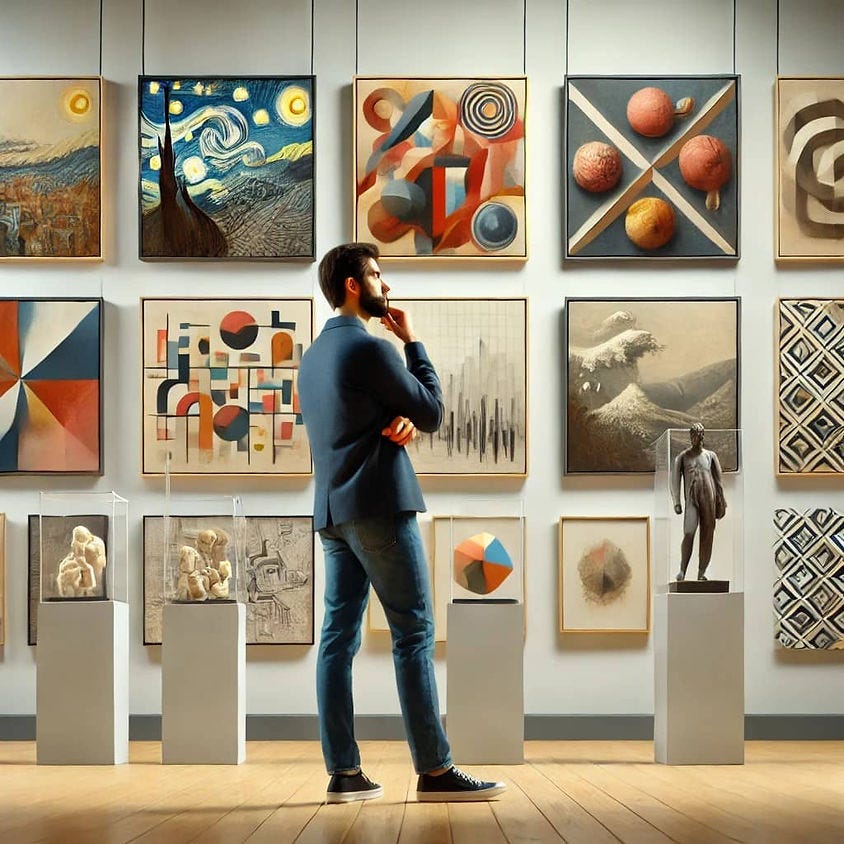
Categorisation is simply the system used to classify and group artworks based on their shared characteristics. To analyze and decode an artwork like a professional, the art world breaks it down into several core layers:
Form: Defines the physical configuration or broad discipline of the artwork (such as a painting, a sculpture, or a three-dimensional installation).
Genre: Refers strictly to the specific subject matter or narrative theme of the work (such as a portrait, a landscape, a still life, or a historical scene).
Medium: The actual physical materials used to create the piece (such as oil on canvas, cast bronze, marble, watercolour, or digital pixels).
Technique: Delves into the specific technical methods the artist used to manipulate their medium (such as glazing in ceramics or thick impasto brushwork in painting).
Style: The distinctive visual language and aesthetic elements that characterise an individual artist or a broader movement (such as Impressionism or Surrealism).
Purpose or Function: The intended role or cultural use of the artwork, whether it was created to be decorative, religious, political, or strictly conceptual.
Cultural or Regional Context: The defining influence of the specific geography, society, or culture where the art was produced, or where the artist hails from, such as traditional African art or Japanese ukiyo-e woodblock prints.
Understanding how these distinct categories intersect helps you appreciate the immense diversity and depth of visual culture, allowing for a far more organised exploration of the vast art world. Let’s analyse these specific and common categorisations in detail:
1. Art Form
An art form refers to the broad physical classification, discipline, or primary shape that an artwork takes. It is the fundamental way we categorise art based on its overall format and presentation. Different art forms allow creators to explore and communicate their ideas in completely diverse ways, each with its own rich history, unique conventions, and expressive possibilities.
Examples of visual art forms include painting, drawing, sculpture, printmaking, photography, and large-scale installations. Each form offers distinct opportunities for expression, allowing an artist to choose the baseline format that best aligns with their creative vision and message.
2. Art Medium
An art medium refers strictly to the specific physical material, substance, or tool used to construct the artwork. If the art form is what type of object it is (e.g., a sculpture), the medium is what it is made of (e.g., clay). The choice of medium plays a crucial role in shaping the final outcome of the work, directly influencing its physical texture, weight, durability, and overall visual aesthetic.
Common examples of art media include clay, oil or acrylic paint, marble, bronze, charcoal, graphite, canvas, digital software, or even the artist’s own body (in the case of performance art). Each medium brings its own distinct characteristics, presenting various possibilities and physical challenges that help a visual artist realise their vision. The choice of material is often closely linked to the artist’s intended message, the desired visual effect, and the practical considerations of how the artwork will be displayed or preserved.
3. Art Technique
An art technique refers to the specific technical methods, processes, and skills that artists apply to manipulate their chosen medium. While the medium is the raw material, the technique is the actual how—the craftsmanship and physical mastery behind the execution. These techniques define the surface style, texture, and immediate visual impact of the artwork, reflecting the artist’s unique physical approach to the canvas or sculpture.
Art techniques vary widely depending on the chosen medium:
In Painting: Common historical and contemporary techniques include pouring (made famous by Jackson Pollock, who dynamically dripped, poured, and flung household gloss paint onto flat canvases), impasto (applying thick, heavy paint that stands out from the surface), glazing (layering thin, translucent colours), sfumato (smoky blending of tones), and dry brushing.
In Sculpture: Masters rely on specific technical methods such as carving (subtractive methods using stone or wood), modelling (additive shaping with clay or wax), casting (pouring liquid metal or resin into a mold), and assemblage (piecing found objects together).
In Mixed Media: This domain utilizes hybrid techniques like collage, mosaic, and kinetic construction (building parts that physically move).
Ultimately, every technique offers distinct possibilities for visual expression. Artists carefully select their methods based on the specific optical effects they wish to achieve and the physical behavior of the materials they prefer to work with.
4. Art Genre
An art genre is a classification used to categorise artworks based on the specific subject matter or object being depicted. Genres help to organise and group art, making it easier to analyze and discuss different thematic approaches. Each genre typically comes with its own historical conventions and characteristics, guiding both the creator’s execution and the viewer’s interpretation.
Within Figurative (Representational) Art: The concept of genre is most clearly defined here, as the work relies on literal subjects. Common genres include Still Life, Landscape, Portraiture, and Genre Painting (scenes depicting everyday life).
Within Abstract Art: From a strict academic standpoint, pure abstraction does not have “genres” because it lacks a literal subject matter. Instead, the art world divides abstraction into distinct stylistic modes or sub-movements. Examples of these abstract classifications include Abstract Expressionism, Geometric Abstraction, Colour Field Painting, Lyrical Abstraction, and Minimalism.
Standalone Human-Centric Categories: There are also overarching narrative groupings focused directly on the human condition or philosophy, such as Narrative Art (art that tells a story) and Conceptual Art (where the idea takes precedence over the subject).
Understanding art genres and thematic modes helps viewers recognise patterns, historical influences, and the broader context in which an artwork was created, deeply enriching your overall appreciation of the piece.
5. Art Style
An art style refers to the distinct visual identity, formal qualities, and choices that set a body of work apart from others. It encompasses the specific techniques, themes, and visual elements that give an artwork its unique character. A style can define a single artist, a specific historical period, a geographic location, a movement, or an entire ancient culture.
A fascinating aspect of style is that it is fluid; a single artist can completely shift their style over the course of their career, dividing their life’s work into distinct visual chapters.
Let’s examine the primary types of art styles:
Artist-Specific Styles: Some artists develop a highly unique, signature visual language that becomes instantly recognisable and synonymous with their name (such as the distinct brushwork of Vincent van Gogh).
Period-Specific Styles: Visual characteristics often dominate entire historical eras, shaped by the cultural, social, and political values of that time (such as the ornate, gilded styles of the Rococo period).
School or Location-Based Styles: Styles can be closely linked to specific geographic regions or schools where artists worked in close proximity and shared technical philosophies (such as the earthy tones of the Barbizon School).
Art Movement Styles: These are defined by collective groups of artists intentionally exploring new visual concepts together (such as the fractured perspectives of Cubism or the dream-states of Surrealism).
The Evolution of an Artist’s Style: Artists frequently pivot as they encounter new personal developments or cultural influences. A prime historical example is Pablo Picasso, whose style evolved dramatically through his Blue Period, Rose Period, and his breakthrough into Cubism.
Contemporary and Hybrid Styles: In today’s art world, contemporary styles frequently blur traditional boundaries, seamlessly combining elements from different movements, historical eras, cultures, and digital media.
Art style is a vital factor in how artworks are categorised, valued, and studied. By identifying the style of a piece, you gain immediate insight into the artist’s underlying intentions, the historical trends of their era, and the cultural values that influenced the creation of the work.
6. Art Purpose or Function
Why was the artwork created, and what role does it serve in society?
The purpose or function of an artwork forms a major division in visual art, sorting pieces by their practical, emotional, or societal use. This includes categories such as fine art, decorative art, applied art, public art, religious or spiritual art, historical art, commemorative art, and commercial art. Essentially, it classifies artworks based on their intended role or the message they convey within a culture.
Different forms of art serve vastly different purposes, ranging from purely aesthetic enjoyment to practical architectural applications, political communication, or spiritual devotion. Understanding the underlying function of an artwork helps us appreciate not just its visual elements, but also its broader impact and significance within a specific context.
Let’s briefly look at the primary categories:
Fine Art: Created primarily for intellectual, aesthetic, or emotional exploration, fine art invites the viewer into a contemplative, deeply reflective experience. While it can yield a financial return, commercial success is rarely immediate; Vincent van Gogh, for example, famously sold only one documented painting (The Red Vineyard) during his lifetime. Sadly, global markets rarely compensate living creators consistently. Working in this space myself, I know firsthand the immense challenge of building a commercial market for conceptual work that demands an artist’s absolute time, soul, and emotional energy.
Decorative Art: Decorative art fuses aesthetic appeal with functional design, enhancing everyday objects and interior spaces like ceramics, textiles, or furniture. Because it is often produced to align with specific room aesthetics, it frequently captures shifting interior design fads. In my view, social media algorithms and mainstream media have heavily overemphasised decorative art at the expense of deeper work. For serious collectors, this raises a critical question: does decorative trend-art actually hold any long-term value once the passing trend cycle ends?
Applied Art: Applied art involves the practical application of artistic principles to the design of physical objects or environments. This includes highly specialized fields like graphic design, industrial design, fashion design, and interior design.
Public Art: Public art is created specifically to be displayed in open, communal spaces, making it accessible to a broad, diverse audience. This category encompasses large-scale outdoor murals, public sculptures, community installations, and civic monuments.
Religious or Spiritual Art: This type of art is created to inspire devotion, teach sacred narratives, or represent spiritual beliefs. Religious art can be found throughout history in various forms, including sacred icons, altarpieces, stained glass windows, and monumental sacred architecture.
Historical Art: Historical art aims to depict, document, or commemorate specific events, figures, or eras from the past. This category includes classical and modern works that preserve pivotal human moments, such as battles, political treaties, or cultural milestones.
Commemorative Art: Closely tied to historical art, commemorative art is created specifically to honor or remember individuals, tragedies, or triumphs. This usually takes the form of public statues, war memorials, honor plaques, or dedicated spaces like memory gardens and museums.
Commercial Art: Commercial art is produced primarily for commercial gain, explicitly aimed at advertising, marketing, or promoting products and corporate services. This includes posters, billboards, packaging design, and multi-media campaigns. It is heavily mass-produced and overemphasized in today’s landscape, frequently weaponized by major corporations to manipulate consumers into buying meaningless trinkets.
Political Art: Political art, which often overlaps with public art, is created to express political opinions, critique social injustices, or advocate for systemic change. This form serves as a powerful tool for activism, challenging the status quo and sparking vital public discourse.
Educational Art: Educational art is created with the primary intent to inform, illustrate, or instruct the viewer about a specific subject. This includes precise scientific illustrations, medical diagrams, instructional graphics, or contemporary artworks designed to visually explain complex theoretical ideas.
Understanding the purpose or function of an artwork provides direct insight into why it was created and how it fits into our wider cultural fabric. It helps buyers look past the surface layer, allowing them to appreciate the different roles that art plays—from serving as a tool for global communication to enriching our daily private lives with deep meaning and beauty.
7. Cultural or Regional Context in Art
Cultural and regional context in art is a categorisation based on the diverse traditions, histories, and backgrounds found across different parts of the world. It provides a vital framework for understanding how distinct environments shape artistic practices and expressions. Ultimately, it highlights the importance of considering the geography and heritage of both the artist and the audience when interpreting and appreciating art.
Prominent historical examples include African, Asian, Indigenous, Islamic, Latin American, Oceanic, and European art, among many others. Each of these categories underscores how art is never merely an aesthetic endeavour, but also a profound reflection of cultural identity, history, and values.
Here are the key aspects that shape cultural and regional context:
Historical Influence: The historical background of a region significantly impacts its creative output. Pivotal events such as trade, migration, and colonisation can introduce entirely new materials, techniques, and themes to a local landscape.
Cultural Values and Beliefs: Art frequently reflects the core values, spiritual beliefs, and social norms of a society. This can encompass religious practices, social hierarchies, and deeply rooted communal traditions.
Regional Materials and Techniques: The materials and technical methods used in art are heavily influenced by the physical environment. Artists naturally use mediums that are readily available in their geography, which organically leads to distinct, localised styles.
Symbolism and Themes: Different cultures use specific visual symbols to convey deep, layered meaning. These symbols are often unique to a particular community and may require cultural context to be fully understood by observers outside of that environment.
Social and Political Context: The contemporary social and political climate of a region heavily influences the purpose of its art. Art can serve as a powerful form of expression, resistance, or commentary on current social issues, explaining why certain themes become prevalent in specific areas.
Cultural Exchange: Interaction between different societies through global trade or travel leads to a rich exchange of artistic styles. While historical cross-cultural friction has its complexities, positive dialogues in a modern, multicultural society like Australia create beautiful, community-based exchanges. While some contemporary circles debate the boundaries of cultural appropriation, genuine, respectful cross-cultural inspiration is often a profound form of appreciation. When artists from different backgrounds are authentically moved by one another’s regional contexts, it enriches the entire creative landscape. It leaves us to wonder: what incredible new art movements will spring out of these harmonious creative dialogues?
For collectors, tuning into cultural and regional context is vital for both ethical acquisition and identifying shifting global market trends. In today’s highly interconnected and multicultural international art market, recognising these geographical and heritage roots helps you verify provenance and appreciate the authentic, unfiltered voice behind a piece.
Ultimately, evaluating art through a regional lens allows you to look past fleeting, Western-centric trends and build a sophisticated, globally minded collection that is deeply rooted in genuine human history and diverse perspectives.
Category Tip for Collectors
To easily decode any artwork when looking at a gallery wall label, you can run through a quick mental checklist that connects the physical object to its deeper meaning.
Start with the immediate visual foundation by identifying the broad art FORM (such as a painting or sculpture) and its specific GENRE or subject matter (like a landscape or portrait).
From there, look closely at the craftsmanship, noticing the physical MEDIUM the artist selected (like oil on canvas or bronze) and the technical TECHNIQUE they used to manipulate those raw materials (such as thick impasto brushwork or casting).
Once you understand how the piece was physically constructed, zoom out to look at the broader context. Notice the overarching visual STYLE (whether it’s a historic movement like Cubism or an artist’s unique visual signature), and consider the artwork’s underlying PURPOSE OR FUNCTION, distinguishing whether it was created as a deep, conceptual piece of fine art or a trend-driven piece of decorative art.
Finally, ground everything in its CULTURAL OR REGIONAL CONTEXT, recognizing how the artist’s geographic heritage shapes the symbols and narratives embedded in the work.
Intersecting these seven layers allows you to look past the surface of any canvas, giving you the ultimate confidence to analyze your collection like an experienced curator.
Conclusion
Imagine a world where art and nature meet, where imagination and reality blur into a beautiful, living paradise.
Imagine a society where artists and engineers build our towns and homes in harmony with the natural world, rather than crowding the earth with sterile concrete jungles. In a world driven by love rather than purely capitalistic metrics, artists would be truly encouraged to bring out their innermost selves. Look at what Spain allowed Antoni Gaudí to do in Barcelona, his unique architectural expressions created a timeless cultural destination that inspires millions to this day.
All of these academic categories, sorting systems, and divisions are ultimately just tools. They exist so that we can quantify, discuss, and communicate about art in a data-obsessed world.
But beneath the labels, I believe that every artist possesses their own “unique creative stream.” When you combine a human being’s distinct fabrics of influence, personal life experiences, and style, you get something that defies a factory processing center.
As a buyer or art collector, I hope this guide helps you untangle these divisions. Use these categories to find clarity, but ultimately, let your personal connection to an artist’s unique creative stream guide you when selecting the perfect piece for your collection and your home.
Enjoy collecting and exploring the vast world of art!
Regards,
Michal Plis
Visit michalplis.com
Invitation to Shop
If you are looking to add original fine art to your collection, please visit my Shop page. My personal practice focuses on the final frontier of discovering new types of abstract art through the New Roundism movement. You can purchase my work directly from my studio here: michalplis.com/#shop.
References
On Art Categorization & Philosophy
Categories of Art (Kendall L. Walton, The Philosophical Review)
URL: [suspicious link removed]
A History of Six Ideas: An Essay in Aesthetics (Władysław Tatarkiewicz, Springer)
URL: https://link.springer.com/book/10.1007/978-94-009-8817-0
The Principles of Art (R.G. Collingwood, Oxford University Press / Internet Archive)
On Abstract vs. Figurative Art
Concerning the Spiritual in Art (Wassily Kandinsky, Internet Archive)
Art and Illusion: A Study in the Psychology of Pictorial Representation (Ernst H. Gombrich, Princeton University Press)
URL: https://press.princeton.edu/books/paperback/9780691017501/art-and-illusion
Art and Visual Perception: A Psychology of the Creative Eye (Rudolf Arnheim, University of California Press)
URL: https://www.ucpress.edu/book/9780520243835/art-and-visual-perception
On Traditional vs. Contemporary Art Definitions
After the End of Art: Contemporary Art and the Pale of History (Arthur C. Danto, Princeton University Press)
URL: https://press.princeton.edu/books/paperback/9780691163895/after-the-end-of-art
Anywhere or Not at All: Philosophy of Contemporary Art (Peter Osborne, Verso Books)
URL: https://www.versobooks.com/products/1155-anywhere-or-not-at-all
On Fine Art, Useful Art, & Cultural Context
The Invention of Art: A Cultural History (Larry Shiner, University of Chicago Press)
URL: https://press.uchicago.edu/ucp/books/book/chicago/I/bo3633215.html
Art Worlds (Howard S. Becker, University of California Press)
Local Knowledge: Further Essays in Interpretive Anthropology (Clifford Geertz, Basic Books)
URL: https://www.basicbooks.com/titles/clifford-geertz/local-knowledge/9780465041626/
On Modernist Principles & Architecture (For your Conclusion)
Modernist Painting (Clement Greenberg, Landmark Essay / Open Academic Access)
URL: https://www.yorku.ca/caitlin/readings/greenberg_modernist_painting.pdf
Antoni Gaudí: 1852–1926: Antoni Gaudí i Cornet – A Life Devoted to Architecture (Rainer Zerbst, Taschen)
Disclaimer
The research and text in this blog are the result of my own dedication, written with a touch of AI assistance for structuring. As a neurodivergent artist, creating comprehensive guides takes a significant investment of time and energy. This content is copyrighted ©2026 Michal Plis. Written permission is required for reproduction.